If you’ve worked in Georgia, Florida or Ohio, you’ve probably shared a care team with one. If you work in Maryland or Massachusetts, you may never have met one. Certified anesthesiologist assistants, or CAAs, are one of the fastest-growing groups in anesthesia, and they come up in almost every conversation about where CRNA jobs are headed.
People have strong feelings about this one, and this article doesn’t pick a side. It lays out what CAAs are, how many there are, where they can work, and what each side says, so you can decide what it means for your own career.
The short answer
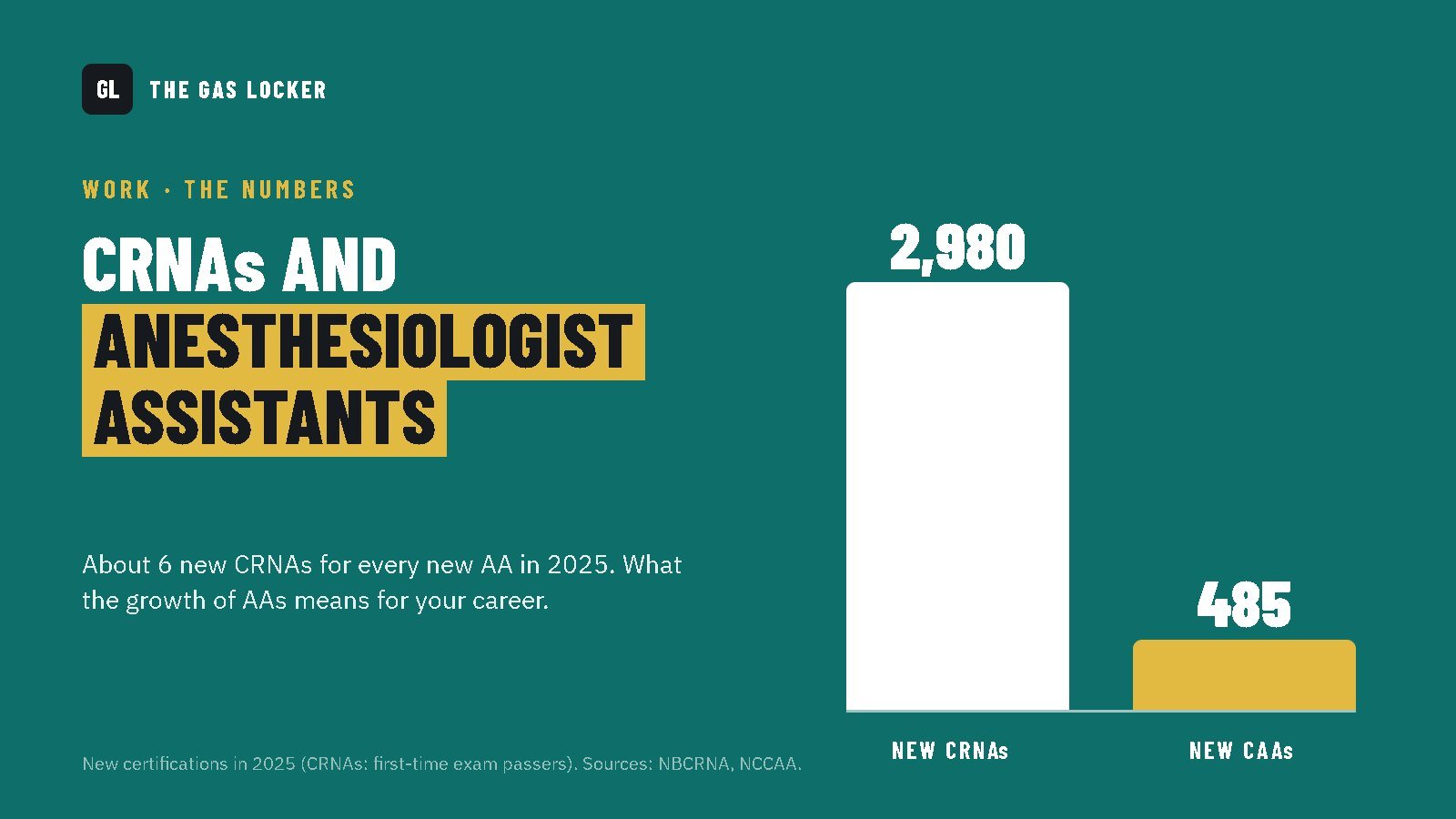
There are about 4,700 certified anesthesiologist assistants in the U.S. and tens of thousands of CRNAs. New CAAs per year have doubled since 2019, from 237 to 485, but CRNAs still add about six new providers for every new CAA. CAAs can work in 24 states and DC, always under an anesthesiologist. Supporters see a second pipeline for growing care teams. CRNA groups raise concerns about scope, supervision and rural access. For most CRNAs the effect is local: it matters most if you work in a CAA state or for a large anesthesiologist-led group.
Who CAAs are
A certified anesthesiologist assistant is a master’s-level anesthesia provider who always works under the direction of a physician anesthesiologist. They’re certified by the NCCAA, and they practice only within the anesthesia care team model.
The biggest difference from CRNAs is the road in. CRNAs come from nursing and critical care. CAAs usually come from a premed science background, and many never worked bedside first.
Two paths to the head of the bed
About 8 years to a CRNA, about 6 to a CAA
Minimum time from the first day of college to the first day of practice
CRNA nursing + critical care route
ICU minimum is 1 year; many applicants work 2–3. Then the NBCRNA exam. Practice in a care team, under supervision, or independently where state law allows.
CAA premed science route
Health care experience preferred, not required. Program runs 24–28 months. Then the NCCAA exam. Practice always under a physician anesthesiologist.
Program lengths and requirements from the ASA’s 2022 comparison statement and the AANA. Minimums shown; real timelines are often longer.
| CRNA | CAA | |
|---|---|---|
| Before school | BSN, RN license, about a year of ICU-type experience | Bachelor’s with premed science courses; health care experience preferred |
| Program | 24–36 months, now doctoral | 24–28 months, master’s |
| Clinical hours | 1,700 minimum (about 2,000 average) | 2,000 minimum (about 2,500 average) |
| How they practice | Care team, surgeon-supervised, or independent where state law allows | Always under a physician anesthesiologist |
Education and clinical figures from the ASA’s 2022 comparison statement.
In the OR, much of the hands-on work looks the same: induction, airway, lines, maintenance and emergence. The difference is who’s legally responsible for the plan, and whether the provider can ever practice without an anesthesiologist. CAAs can’t. CRNAs can in many settings.
Key pointSame OR work, different road in. The real difference is whether you can ever practice without an anesthesiologist. CAAs can’t.
The numbers
CAAs are still a small group, but they’re growing faster than CRNAs in percentage terms. The NCCAA counted 4,718 currently certified CAAs as of July 2026.
Two pipelines
CRNAs still add about 6 for every new CAA
New certifications each year, 2015 to 2025
Sources: NBCRNA NCE annual reports (first-time passers; retakes add roughly 300 a year) and NCCAA certification counts. 2015–2018 CRNA figures are Sept–Aug fiscal years.
In plain terms:
- New CAAs per year more than doubled from 2019 to 2025 (+105%). New CRNAs grew 46% over the same years.
- CRNAs still add about six new providers for every new CAA. In raw numbers, CRNA growth is much bigger.
- The share is shifting. In 2019 it was closer to nine to one.
- Nineteen CAA programs had graduates in 2025, according to their accrediting body (ARC-AA).
So the honest read: CAAs aren’t about to outnumber CRNAs anywhere soon. But in the states where they practice, they’re a growing part of the supply, alongside the record CRNA classes covered in Too Many CRNAs? The Early Signs Are Already Here.
Key pointCAAs are growing fast, but from a small base. CRNAs still add about six new providers for every new CAA.
Where CAAs can work, and where they’re pushing next
The ASA counts 24 jurisdictions that authorize CAAs, including DC. Most license them directly. Four (Kansas, Michigan, Pennsylvania and Texas) allow them through physician delegation instead of a CAA law.
The map
24 jurisdictions, and the newest four all arrived since 2023
Where certified anesthesiologist assistants can practice, as of 2026. Tap a state.
Sources: ASA (24 jurisdictions) via Becker’s ASC; state legislatures. Map outlines: U.S. Census Bureau.
States that have added or expanded CAA practice recently
| Year | State | What changed |
|---|---|---|
| 2025 | Tennessee, Virginia | New licensure laws (Virginia’s rules are still being written) |
| 2025 | South Carolina | Higher supervision ratio |
| 2024 | Washington | New licensure law |
| 2023 | Nevada | New licensure law |
| 2023 | New Mexico | Wider practice area and higher ratio |
2026 so far: more bills, no new states. Licensure bills were filed in several places, including Maryland (SB 951 / HB 1558), Kansas and Michigan. The Kansas bills died in committee. Maryland’s bill got a hearing date but no committee vote. Michigan’s is still in committee. By one tracker’s count, no new CAA state was added in 2026.
The pattern is steady pressure, state by state, with wins in some years and stalls in others. If you work in a state with a pending bill, it’s worth following your state association’s updates.
In most CAA states, one anesthesiologist can direct up to four CAAs at a time. That matters, because it’s the same care team math many groups already use with CRNAs.
Key pointSteady pressure, state by state. Four states added since 2023, none so far in 2026.
The case for AAs
Here’s the view from anesthesiologists and CAA supporters, in their own terms.
- More hands for a growing caseload. Surgical volume keeps rising, especially in outpatient centers. Supporters argue a second pipeline helps groups staff rooms without relying on a single profession.
- Same team, same work. The ASA’s position is that CAAs and nurse anesthetists “share identical patient care responsibilities” within the care team. Its comparison found no evidence that the training differences lead to a gap in skills or quality of care when an anesthesiologist directs the team.
- A deep training pipeline. CAA programs draw on premed graduates, a large pool that doesn’t compete with the ICU nursing workforce hospitals also need.
- Strong clinical hours. CAA programs require a minimum of 2,000 clinical hours, versus a 1,700-hour minimum for CRNA programs.
The ASA supports authorizing CAA practice in every state.
The concerns CRNAs raise
And here’s the view from the AANA and CRNA groups, in their own terms.
- Different background going in. CRNA programs require critical care nursing experience before school. CAA programs don’t. The AANA points to that bedside experience as a core part of CRNA preparation.
- CAAs can’t practice on their own. CAAs perform tasks delegated by an anesthesiologist and must always be directed by one. CRNAs can plan and deliver anesthesia independently where state law allows. CRNA groups argue that makes CAAs a narrower fix for staffing gaps.
- Rural access. CRNAs make up more than 80% of anesthesia providers in rural counties, according to the AANA. Because CAAs need an anesthesiologist on the team, CRNA groups argue they’re less likely to fill gaps in small and rural hospitals.
- Training seats and teaching. The AANA advises CRNAs not to teach AA students, saying the two roles’ training and scope differ. Clinical training sites are a limited resource for every anesthesia program.
CRNA associations have filed formal opposition when states review CAA licensure, as Nebraska’s nurse anesthetist association did during that state’s credentialing review.
“The AA model has failed to scale because dependent models do not work in modern healthcare.”
Where both sides agree
Strip away the legislative fights and there’s more common ground than the headlines suggest.
- Surgical volume is rising, and someone has to staff the rooms. Nobody disputes that.
- The care team model works. Anesthesiologists, CRNAs and CAAs already share ORs in two dozen states, and both sides point to good safety records there.
- Training hours are substantial on both paths. The ASA’s own comparison puts CRNAs and CAAs within a few hundred clinical hours of each other.
- Patients don’t ask about credentials at 2 a.m. They want a skilled, rested provider who’s paying attention. Both professions train for exactly that.
The real disagreement is narrower than it looks: whether the person at the head of the bed must always have an anesthesiologist directing them. That’s a question about independence, not competence.
Key pointThe real fight is about independence, not competence.
What it means for your career
For most CRNAs, CAAs aren’t the main story. The bigger supply change is the record number of new CRNAs. But depending on where and how you work, CAAs can shape your market.
It matters more if you:
- Work in a CAA state like Georgia, Florida, Ohio or Texas.
- Work for a large anesthesiologist-led care team group, which is where CAAs are hired.
- Are a new grad looking at academic centers or big hospital groups in those states.
It matters less if you:
- Work independently, in an opt-out state, or in a CRNA-only practice.
- Work in rural or critical access hospitals.
- Mostly do 1099 work in surgery centers or offices without an anesthesiologist on site.
Moves that keep you in demand either way
- Build skills that set you apart. Regional blocks, peds, cardiac, OB and difficult airways keep you booked in any staffing model.
- Know your state. Follow your state association on pending bills, so a change never catches you off guard.
- Stay credentialed in more than one place. More sites means more options if one market tightens.
- Be the one people ask for. Reliability, speed at turnover and being easy to work with matter to every group, whatever the mix of providers.
In a lot of ORs, CRNAs and CAAs already clock in side by side and split the same board. Whatever the legislatures decide, the providers who are skilled, flexible and easy to work with are the ones every group fights to keep.

The bottom line
- CAAs are growing, but they’re still a small group. CRNAs add about six for every one.
- The effect is local. It matters most in CAA states and in large anesthesiologist-led groups.
- Your skills are your best protection. Regional, peds, cardiac, OB and airway skills keep you in demand in any model.
FAQ
Are anesthesiologist assistants the same as anesthesia techs?
No. Anesthesia techs support the room with equipment and setup. CAAs are master’s-level providers who deliver anesthesia under an anesthesiologist’s direction.
Can a CAA work without an anesthesiologist?
No. In every state that allows CAAs, they practice under the direction of a physician anesthesiologist.
Can CRNAs work without an anesthesiologist?
In many settings, yes. It depends on state law, facility rules and whether the state has opted out of the Medicare supervision requirement.
Is my state adding CAAs?
Check your state board and your state nurse anesthetist association. Bills come up often, and many stall in committee.
Are CAAs replacing CRNAs?
The numbers don’t show that. CRNAs still add about six new providers for every new CAA each year. In CAA states, the two often work on the same teams.
Do CAAs and CRNAs get paid differently?
On the same care team, often not by much, since they do the same work. The difference is in the paths: CRNAs can practice independently or take 1099 contracts, and CAAs can’t. Pay varies a lot by state and group, so check current postings in your own market.
Sources
- NCCAA: Number of certified CAAs and new certifications by year (as of July 2026)
- ASA: Certified Anesthesiologist Assistants (states and recent laws)
- ASA: Statement comparing CAA and CRNA education and practice (2022)
- ARC-AA: Graduate outcomes
- CAA Guide: CAA states and years added
- AnesthesiaJobs: CAA scope of practice, ratios and 2026 bills
- Maryland General Assembly: SB 951 (2026)
- Maryland Association of Nurse Anesthetists: testimony on SB 951 (2026)
- AANA position on CRNAs teaching AA students (Nebraska credentialing review)
- AANA: CRNAs and rural anesthesia (May 2024)
- NBCRNA NCE and SEE annual report, 2025 (earlier years linked in our oversupply article)
For general information only, not legal or career advice. State laws change, so check your state board for current rules. No affiliate links in this article. Cover chart, map and charts by The Gas Locker. Photo AI-generated via Google Gemini.