
CRNAs can usually put more toward retirement than most workers, but only if they know which accounts they actually have. A CRNA at a public hospital might have both a 403(b) and a 457(b). A 1099 CRNA might have neither, and needs to open a Solo 401(k) or SEP IRA. One with a W-2 job and 1099 side work may qualify for both kinds.
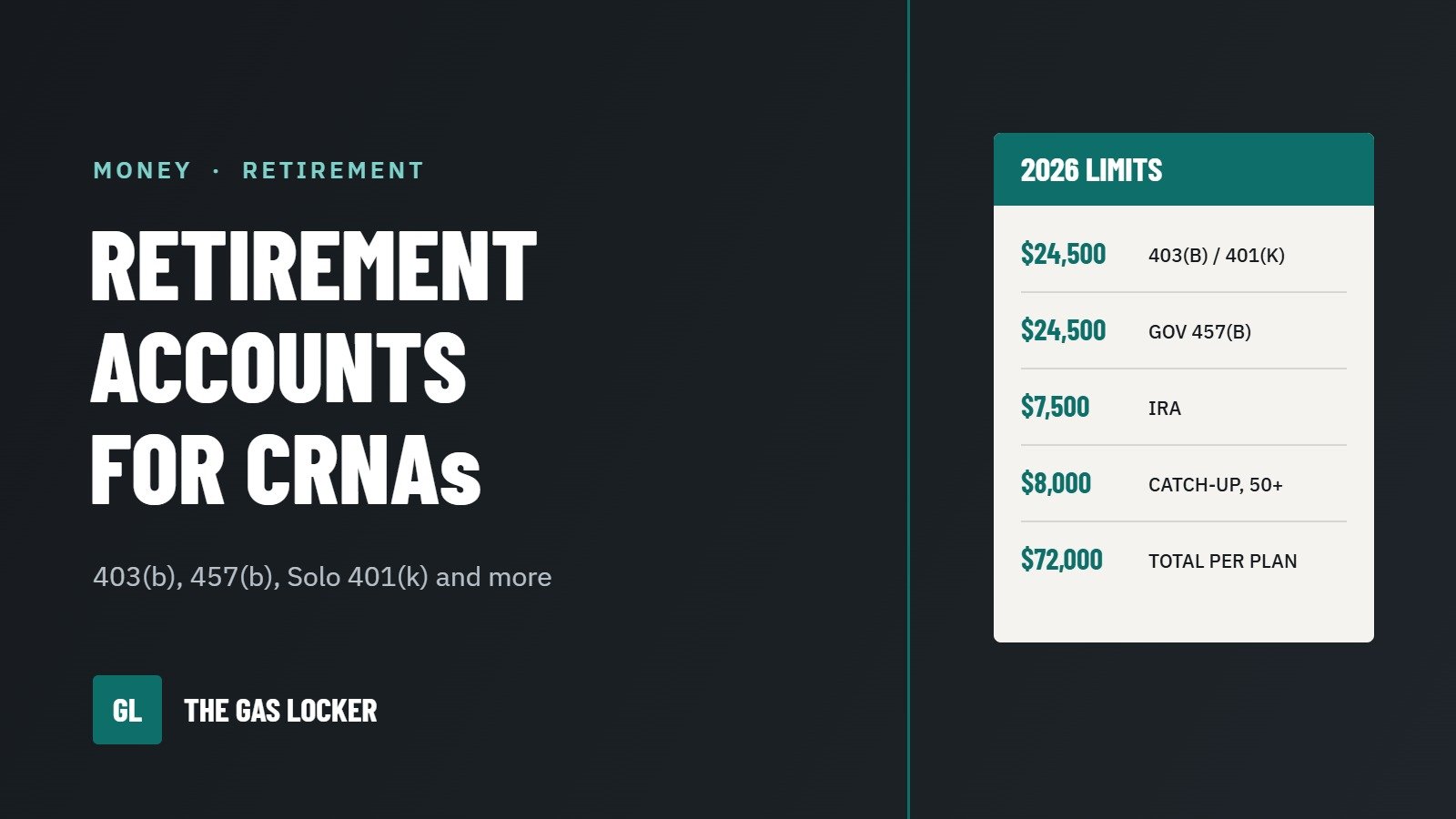
How you’re paid decides which accounts you can use, and the 2026 limits are higher than ever: $24,500 in a 401(k), 403(b) or governmental 457(b), and $7,500 in an IRA (IRS).
This guide walks through each account, how the limits stack, and the mistakes that cost CRNAs the most. If you’re 1099, read it alongside The 1099 CRNA Starter Guide.
Key takeaways
- How you’re paid (W-2, 1099 or both) decides which retirement accounts you can use.
- Collect your full employer match first.
- At a public or nonprofit hospital, ask about a 457(b). A governmental 457(b) has its own $24,500 limit, separate from the 403(b).
- 1099 CRNAs: a Solo 401(k) often lets you save more than a SEP IRA and keeps a backdoor Roth cleaner.
Last reviewed Oct 2026 · Written by a practicing CRNA

Short on time? The three sections that matter most:
2026 limits at a glance
These are the IRS numbers for 2026. Limits change every year, so check the IRS pages before you set contributions (IRS news release; IRS COLA table).
| Limit | 2026 amount | What it covers |
|---|---|---|
| Employee deferral: 401(k), 403(b) | $24,500 | Your own contributions, shared across all your 401(k) and 403(b) plans |
| Employee deferral: governmental 457(b) | $24,500 | A separate limit on top of the 401(k)/403(b) limit |
| Catch-up, age 50+ | $8,000 | Extra deferral in 401(k), 403(b) and governmental 457(b) plans |
| Catch-up, ages 60 to 63 | $11,250 | Replaces the $8,000 if you turn 60 to 63 during the year |
| Total per employer plan (415(c)) | $72,000 | Your deferrals plus employer contributions, not counting catch-ups |
| Compensation counted | $360,000 | Pay above this is ignored when figuring contributions |
| IRA (traditional or Roth) | $7,500 | Shared across all your IRAs |
| IRA catch-up, age 50+ | $1,100 | On top of the $7,500 |
| Roth IRA income phase-out | $153,000 to $168,000 single; $242,000 to $252,000 married filing jointly | Above the range, you can’t contribute to a Roth IRA directly |
Start here: W-2, 1099, or both
The first question isn’t which account is best. It’s how you’re paid, because that decides which accounts you can use at all.
| How you’re paid | Common setups | Accounts you may have |
|---|---|---|
| W-2 employee | Hospital, academic center, anesthesia group, government or VA | Your employer’s 403(b) or 401(k); often a 457(b) at public and nonprofit hospitals; an IRA (often a backdoor Roth) |
| 1099 independent contractor | Locums, per diem, your own S corp or LLC | A Solo 401(k) or SEP IRA that you open yourself; an IRA |
| Both | A W-2 job plus 1099 side shifts | Your employer’s plans plus your own Solo 401(k) or SEP IRA, with shared limits |
If you’re W-2, your options are set by your employer’s plan documents. Ask HR or benefits for the summary plan description, the match formula and whether a 457(b) exists. If you’re 1099, nothing is set up for you, so you have to open the account yourself.
W-2 CRNAs: the 403(b) or 401(k)
Nonprofit and public hospitals usually offer a 403(b); private groups and for-profit companies usually offer a 401(k). For your own contributions they work almost the same way: up to $24,500 in 2026, pre-tax or Roth if the plan offers a Roth option.
Get the full match first. Employer matching money is the easiest return you’ll get. Find the formula (for example, “100% of the first 4%”) and contribute at least enough to collect all of it.
Know your vesting schedule. Your own deferrals are always 100% yours. Employer contributions can vest over time. The IRS gives examples such as 100% after 3 years of service, or 20% a year until 100% in year 6 (IRS: Vesting). If you’re thinking of leaving a job, check where you are on that schedule first.
The limit is per person, not per plan. If you work two W-2 jobs, each with a 403(b) or 401(k), your deferrals to all of them combined can’t exceed $24,500 (IRS). Employers don’t track this for you; you do.
A 403(b) extra for long-time hospital staff. Some 403(b) plans allow a 15-year catch-up: with at least 15 years at the same hospital or other eligible employer, you may be able to defer up to $3,000 more a year, with a $15,000 lifetime cap (IRS: 403(b) limits). Your plan has to offer it, and the math has a few more conditions, so ask the plan administrator.
Often overlooked
The 457(b): the account many CRNAs miss
If your hospital is a public or nonprofit employer, check whether it offers a 457(b). It’s the biggest savings lever many W-2 CRNAs never use.
It has its own limit. The 457(b) limit is separate from the 401(k)/403(b) limit: the IRS says it “is not combined with your deferrals made to a 403(b) or other plans” (IRS). With both plans, you could defer up to $24,500 to each in 2026, or $49,000 total, before any match.
But not all 457(b) plans are the same. Which kind you have matters more than anything else about it.
| Governmental 457(b) | Non-governmental 457(b) | |
|---|---|---|
| Typical employer | State or county hospital, public university, city or state agency | Private nonprofit hospital or health system |
| Who can join | All employees | Only a select group of management or highly paid employees |
| Whose money is it? | Held in trust for you | Stays the employer’s property until paid out; available to its creditors in bankruptcy |
| Age-50 catch-up | Yes | No |
| Roll to an IRA later | Yes | Not listed on the IRS rollover chart; payout rules are set by the plan |
| 10% early-withdrawal tax | Doesn’t apply (except on money rolled in from other plans) | Payouts are taxed when made available; set by plan rules |
Sources: IRS: 457(b) plans; IRS: Non-governmental 457(b) plans; IRS: Rollover chart; IRS: Exceptions to the 10% tax.
The governmental 457(b) has a rare perk. Once you leave that employer, withdrawals aren’t hit with the 10% early-withdrawal tax, even before 59½. That can make it a useful bridge account if you plan to cut back or retire early.
The non-governmental 457(b) carries real risk. The IRS is plain about it: plan assets “remain the property of the employer” and are available to its general creditors. If the health system went bankrupt, you’d stand in line with other creditors. Many CRNAs still use one, but it’s worth weighing how stable the employer is, how much you’d keep there, and what the payout options are when you leave, before you enroll.
Within 3 years of retirement, both kinds may allow a special catch-up that uses limits you didn’t fill in earlier years. In a governmental 457(b), you can’t use it in the same year as the age-50 catch-up (IRS: 457(b) vs 401(k)). The rules are detailed; ask your plan administrator.
1099 CRNAs: Solo 401(k) or SEP IRA
As a 1099 CRNA with no employees, you’re both the employer and the employee. The two accounts most solo CRNAs choose between are the Solo 401(k) and the SEP IRA.

| Solo 401(k) | SEP IRA | |
|---|---|---|
| Who can use it | A business owner with no employees (a spouse can join) | Any self-employed person; if you hire staff, they must be covered too |
| Your “employee” deferral | Yes, up to $24,500 in 2026 (plus catch-up if 50+) | No |
| “Employer” contribution | Up to 25% of compensation | Up to 25% of compensation |
| 2026 total cap | $72,000, plus catch-up | $72,000 |
| Roth option | Depends on the provider | Depends on the provider |
| Paperwork | Form 5500-EZ once the plan holds $250,000 or more | Minimal |
| Latest setup date | The tax-filing deadline, without extensions (for a sole proprietor with no employees) | The tax-filing deadline, including extensions |
Sources: IRS: One-participant 401(k); IRS: SEP; IRS Publication 560.
What “25% of compensation” really means when you’re self-employed. Your compensation isn’t your 1099 total. It’s net profit minus half of your self-employment tax and minus the contribution itself. The IRS’s method turns that into a reduced rate: a 25% plan rate works out to 20% of net profit after the self-employment tax deduction (25 ÷ 1.25) (IRS: Calculating your own contribution).
A worked example. Say you’re a sole-proprietor 1099 CRNA, under 50, with $200,000 of net profit in 2026 and no other retirement plan:
- Self-employment tax: about $28,234 (Social Security on earnings up to the 2026 wage base of $184,500 (SSA), plus Medicare). Half of it, about $14,117, is deductible.
- Net profit minus that half: about $185,883.
- “Employer” contribution at 20%: about $37,177. That’s the most a SEP IRA allows here.
- A Solo 401(k) adds the $24,500 “employee” deferral on top: about $61,677 in total, under the $72,000 cap.
At this income, the Solo 401(k) lets you save about $24,500 more than a SEP. That gap is why many 1099 CRNAs choose the Solo 401(k). The SEP still has a place: it’s simpler, and you can open and fund it as late as your extended filing deadline.
If you run your work through an S corp, the math is different: contributions are based on the W-2 salary you pay yourself, not your profit. Work that out with your CPA. The 1099 CRNA Starter Guide covers the business-structure basics.
Rounded figures, one simplified scenario. Your own numbers depend on your entity, deductions and other plans.
W-2 plus side work
W-2 plus 1099 side work: how the limits stack
Plenty of CRNAs have a W-2 job and pick up 1099 shifts on the side. You can have a Solo 401(k) or SEP IRA for the side work, but three rules decide how much it adds.
- Your $24,500 employee deferral is shared. It covers all your 401(k) and 403(b) plans combined, whoever sponsors them (IRS). If you already max your hospital 403(b), your Solo 401(k) gets no employee deferral that year.
- The 457(b) stays separate. A governmental 457(b) deferral doesn’t use up any of that $24,500.
- The “employer” side still works, but watch the 403(b) rule. Your side business can still make its own “employer” contribution of up to 20% of net self-employment earnings. If your W-2 plan is a 403(b), IRS Publication 571 says your 403(b) contributions must be combined with those to plans of any business you control (more than 50%) when you check the $72,000 annual limit (IRS Pub. 571).
An example. A CRNA at a county hospital, under 50, defers $24,500 to the 403(b) and $24,500 to the governmental 457(b). She also nets $50,000 from 1099 shifts and opens a Solo 401(k):
- Employee deferral to the Solo 401(k): $0, because the 403(b) already used the $24,500.
- “Employer” contribution: about $9,900 (20% of the $50,000 after the half self-employment tax deduction, assuming her W-2 pay already tops the Social Security wage base).
- Total from her own paycheck and side work: about $58,900 a year, before any hospital match. Her 403(b) plus the Solo 401(k) stays well under the combined $72,000.
A common order: collect the full W-2 match, use the 457(b) if it’s governmental (or if you’ve weighed the risk of a non-governmental one), then the 403(b) or 401(k), then the side-business plan. Since the rules interact, have a CPA check the numbers before year-end.
Roth or pre-tax, and the backdoor Roth
Pre-tax vs Roth. Pre-tax contributions lower your taxes now; you pay tax when you withdraw. Roth contributions are taxed now; qualified withdrawals later are tax-free, and a Roth IRA has no required minimum distributions for the original owner (IRS: Traditional and Roth IRAs). The question is whether your tax rate is higher now or in retirement, which nobody knows for sure. Many people split contributions between the two to hedge.
The backdoor Roth. Most CRNAs earn too much to contribute to a Roth IRA directly: in 2026 the ability phases out between $153,000 and $168,000 for single filers and between $242,000 and $252,000 for married couples filing jointly (IRS). But conversions have no income limit: “regardless of the amount of your adjusted gross income, you may be able to convert” a traditional IRA to a Roth IRA (IRS Topic 309). So the “backdoor” is two steps:
- Make a nondeductible contribution to a traditional IRA (up to $7,500 in 2026).
- Convert it to your Roth IRA.
You report both on Form 8606 (IRS: Form 8606 instructions).
The pro-rata trap. When you convert, the IRS looks at the total in all your traditional IRAs on December 31, and that includes SEP IRAs and SIMPLE IRAs (IRS: Form 8606 instructions). If you have $93,000 of pre-tax money in a SEP IRA and convert a $7,500 nondeductible contribution, most of the conversion becomes taxable, not just the growth.
This is a real reason some 1099 CRNAs choose a Solo 401(k) over a SEP: 401(k) money isn’t counted in that IRA total. Some people also move old pre-tax IRA money into a workplace plan that accepts roll-ins before doing a backdoor Roth. Check with a CPA before you try either.
New in 2026: Roth catch-ups for higher earners. If you’re 50 or older and earned more than $150,000 in wages from your employer in the prior year, your catch-up contributions to that employer’s plan must go in as Roth (IRS: Catch-up contributions). If you’re over 50, check last year’s W-2 from that employer and plan for Roth catch-ups if it was above $150,000.
Catch-ups after 50, and the HSA as a bonus account

Catch-up contributions. From the year you turn 50, you can add $8,000 to a 401(k), 403(b) or governmental 457(b) in 2026. If you turn 60, 61, 62 or 63 during the year, that becomes $11,250. IRAs get an extra $1,100 (IRS).
A CRNA at a public hospital who is 61 and has both a 403(b) and a governmental 457(b) could, if both plans allow catch-ups, defer up to $35,750 to each in 2026 ($24,500 + $11,250). Remember that the catch-ups may have to go in as Roth if last year’s wages topped $150,000.
The HSA. It isn’t a retirement account, but it can act like one. If you have a high-deductible health plan, an HSA gives you three tax breaks: deductible contributions, tax-free growth, and tax-free withdrawals for qualified medical expenses. After 65, withdrawals for anything else are taxed as income but no longer get the extra 20% penalty (IRS Pub. 969).
| 2026 HSA | Limit |
|---|---|
| Self-only coverage | $4,400 |
| Family coverage | $8,750 |
| Extra if 55 or older | $1,000 |
Source: IRS Rev. Proc. 2025-19; IRS Pub. 969.
To use it as a long-term account, some people pay current medical bills out of pocket, keep the receipts, and leave the HSA invested.
Avoid these
Common mistakes
- Leaving the match on the table. Contributing less than the match formula is giving back part of your pay.
- Never asking about a 457(b). At public and nonprofit hospitals it may be there, separate from the 403(b), and not well advertised.
- Not checking which 457(b) you have. A non-governmental plan keeps your money exposed to the employer’s creditors, with no age-50 catch-up and no IRA rollover listed on the IRS chart.
- Over-contributing across two jobs. The $24,500 deferral limit is yours, not each employer’s. Two W-2 plans, or a 403(b) plus a Solo 401(k), share it.
- Opening a SEP IRA, then trying a backdoor Roth. The SEP balance counts in the pro-rata math and can make the conversion mostly taxable.
- Figuring 1099 contributions on gross pay. Self-employed contributions come from net profit after half of self-employment tax, not your 1099 total.
- Missing the setup deadline. A Solo 401(k) for a sole proprietor must be adopted by the filing deadline without extensions; a SEP can wait until the extended deadline (IRS Pub. 560).
- Forgetting Form 5500-EZ. Once a Solo 401(k) holds $250,000 or more at year-end, it generally has to file (IRS).
- Leaving before you vest. Changing jobs a few months before an employer contribution vests can cost thousands.
Once your retirement accounts are set, 7 Passive Income Ideas for CRNAs covers what you can build on top of them.
FAQ
Can I contribute to both a 403(b) and a 457(b)?
Yes, if your employer offers both. The 457(b) has its own limit, so in 2026 you can defer up to $24,500 to each, plus catch-ups if you’re 50 or older and both plans allow them.
I’m a 1099 CRNA. Should I open a Solo 401(k) or a SEP IRA?
A Solo 401(k) allows the same “employer” contribution as a SEP plus the $24,500 employee deferral, so it usually allows more. It also keeps a backdoor Roth clean. A SEP is simpler and can be opened later, up to the extended filing deadline. If you hire employees, the rules change for both.
Can I have a Solo 401(k) if I also have a 403(b) at my W-2 job?
Yes, for your 1099 income. Your employee deferral limit is shared between the two, and with a 403(b), contributions are combined with plans of a business you control when checking the $72,000 limit.
Can I still do a backdoor Roth if I have a SEP IRA?
You can, but the SEP balance counts in the pro-rata calculation, so part or most of the conversion may be taxable. Talk to a CPA first.
Is a non-governmental 457(b) worth it?
It depends on the employer’s financial strength, how much you’d keep in it, and the payout options when you leave. The money stays the employer’s property and is exposed to its creditors until paid out. Read the plan document before you enroll.
Do I lose my retirement money if I change jobs?
No. Your own contributions are always yours. Employer contributions follow the vesting schedule. Most 401(k), 403(b) and governmental 457(b) money can be rolled into an IRA or a new employer’s plan.
Sources
- IRS: 401(k) limit increases to $24,500 for 2026, IRA limit increases to $7,500
- IRS: COLA increases for dollar limitations on benefits and contributions
- IRS: How much salary can you defer if you’re eligible for more than one retirement plan?
- IRS: Retirement topics, 403(b) contribution limits
- IRS Publication 571: Tax-Sheltered Annuity Plans (403(b) Plans)
- IRS: IRC 457(b) deferred compensation plans
- IRS: Non-governmental 457(b) deferred compensation plans
- IRS: Comparison of governmental 457(b) plans and 401(k) plans
- IRS: Rollover chart
- IRS: Exceptions to tax on early distributions
- IRS: Retirement topics, vesting
- IRS: One-participant 401(k) plans
- IRS: Simplified Employee Pension plan (SEP)
- IRS Publication 560: Retirement Plans for Small Business
- IRS: Self-employed individuals, calculating your own retirement plan contribution and deduction
- SSA: Contribution and benefit base
- IRS: Traditional and Roth IRAs
- IRS Topic 309: Roth IRA contributions
- IRS: Instructions for Form 8606
- IRS: Retirement topics, catch-up contributions
- IRS Rev. Proc. 2025-19 (2026 HSA limits)
- IRS Publication 969: Health Savings Accounts
This is educational content based on IRS rules and published guidance, not financial, tax or legal advice. Rules depend on your plan documents and your tax situation. There are no affiliate links in this article. General information, not financial, tax or legal advice. Retirement plan rules depend on your plan documents, employer and tax situation, and limits change every year. Check current IRS figures and talk to a CPA or fee-only financial planner before you make decisions. Image credits: Image: AI-generated via Canva.