
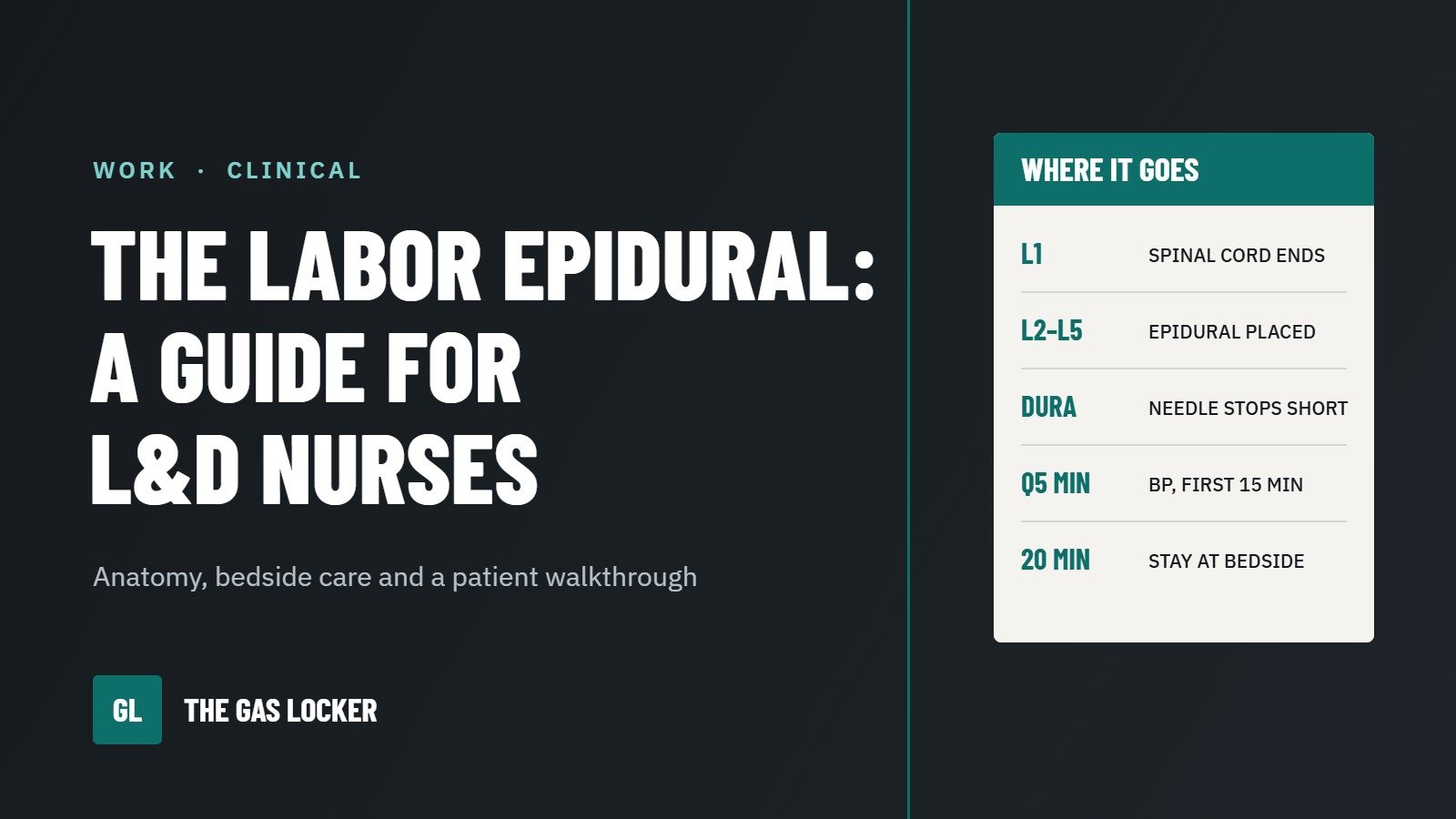
The anesthesia provider places the epidural, but the L&D nurse is the one at the bedside for the hours that follow. You prep the patient, hold her steady during placement, catch the blood pressure drop, and answer the same questions at every shift change. This guide is built for that job.
It’s a big job. CDC data show epidural or spinal use for singleton vaginal births rose from 69.8% in 2016 to 75.4% in 2024 (NCHS, 2026). That’s roughly 3 in 4 vaginal births nationally.
You’ll find the anatomy in plain terms, what to do before, during and after placement, the red flags that need anesthesia now, and plain-language scripts you can use with patients.
Key takeaways
- A labor epidural goes in below where the spinal cord ends, usually between L2 and L5, outside the dura.
- The first 20–30 minutes after dosing are the watch window: stay at the bedside and check BP often.
- Call anesthesia now for numb hands, trouble breathing, toxicity signs, stubborn hypotension or persistent fetal heart rate changes.
- Nurses monitor the epidural and anesthesia manages it: no rate changes or boluses.
Last reviewed Oct 2026 · Written by a practicing CRNA
Short on time? The three sections nurses use most:
The anatomy: where the epidural goes, and why it misses the cord
The spinal cord ends around the first lumbar vertebra, and a labor epidural goes in lower, usually between L2 and L5, into a space outside the membrane around the nerves. Knowing this is what lets you answer the paralysis question with confidence.
The cord stops high. In adults, the cord tapers to an end called the conus medullaris, most often at L1, with a normal range from about T12 to L2 (MRI study of 629 adults). Below that, the canal holds the cauda equina: loose nerve roots floating in cerebrospinal fluid (CSF).
The layers the needle crosses, from the skin inward:
- Skin and subcutaneous fat
- Supraspinous ligament
- Interspinous ligament
- Ligamentum flavum (the thick “yellow ligament” the provider feels the needle pass)
- The epidural space, where the needle stops and the catheter is threaded
Just past the epidural space is the dura, the sac that holds the CSF. The epidural is meant to stay outside it. If the needle goes through, that’s an accidental dural puncture, the cause of the classic postpartum positional headache you’ll be watching for later.
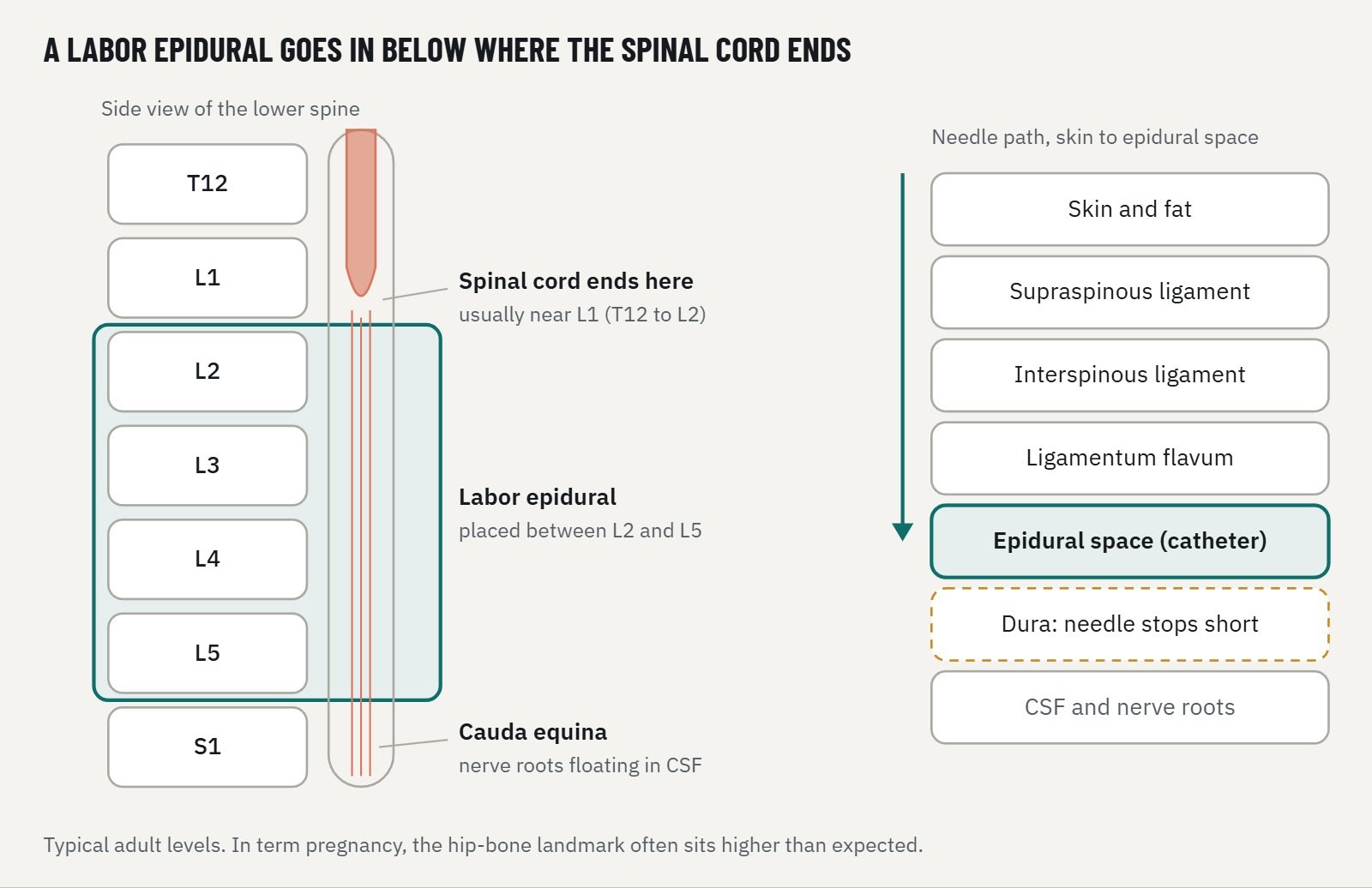
Why the level matters. Providers estimate the level by feeling the tops of the hip bones (Tuffier’s line), classically at L4 or L4-L5. In term pregnancy, that palpated line often sits higher, with a median just below L2-L3 in one study (Margarido et al., Can J Anesth 2010). So anesthesia aims low. It matters most when a spinal needle is used (combined spinal-epidural or dural puncture epidural): a large imaging review found the cord ends at or below L1-L2 in about 19% of people, but at or below L2-L3 in only 0.7% (Paul et al., Acta Anaesthesiol Scand 2025).
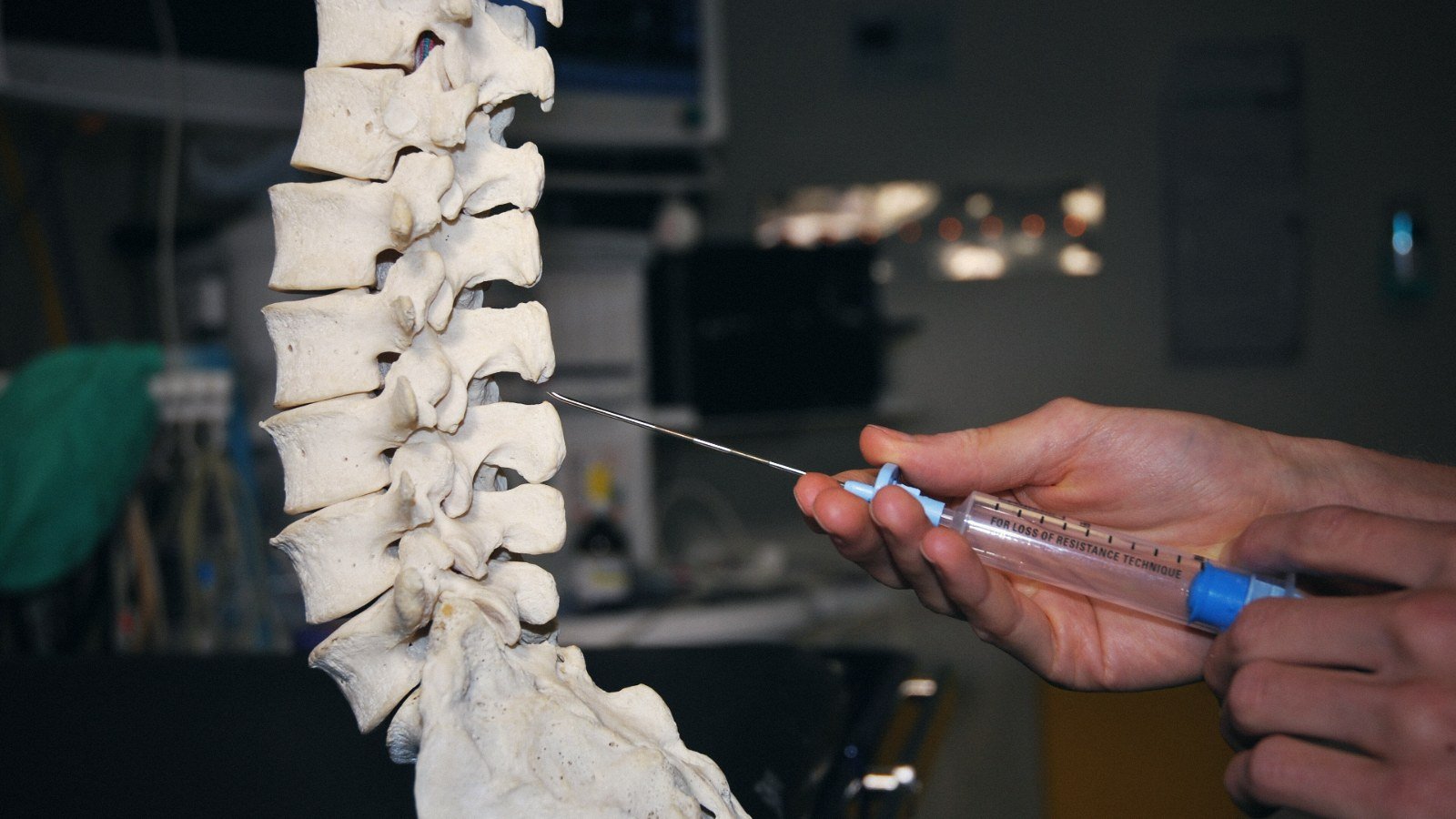
Say it like this: “Your spinal cord ends higher up in your back. The epidural goes in below that, into a space outside the sac around your nerves. Only a tiny, soft tube stays in, not a needle.”
How it works, and what each piece means at the bedside
The needle comes out; a thin, soft catheter stays in. That catheter carries a low dose of medication for as long as labor lasts, and can be dosed up for a cesarean if needed.
- The medication. Usually a dilute local anesthetic (bupivacaine or ropivacaine) plus a small dose of opioid (fentanyl or sufentanil). The low concentration blocks pain more than movement, so most patients can still shift and feel pressure. At the bedside: the opioid is why itching is common; the local anesthetic is why blood pressure drops and legs get heavy.
- The pump. Continuous infusion or programmed intermittent boluses, usually plus a patient-controlled button (PCEA). At the bedside: check the pump and line each assessment, and teach the patient how and when to use her button.
- The techniques.
- Standard epidural: catheter only. Relief builds over roughly 15 to 20 minutes.
- Combined spinal-epidural (CSE): a small dose goes into the CSF first for relief in minutes. At the bedside: watch the fetal heart rate and blood pressure closely in the first 15 to 30 minutes, when fast pain relief can trigger a brief fetal heart rate drop.
- Dural puncture epidural (DPE): a tiny dural hole, no spinal drug. It can help the epidural spread evenly.
Say it like this: “The medicine numbs the nerves that carry labor pain. You’ll still feel pressure, and that’s normal. If pain comes back, press your button or call me.”
Patient walkthrough
Walk your patient through it
A patient who knows what’s coming holds stiller, worries less and reports problems sooner. Here’s the whole experience in order, with what she’ll feel and words you can use.
Before: deciding and getting ready
She can have it whenever she asks. ACOG states that, without a medical contraindication, a patient’s request is reason enough for labor pain relief (ACOG Practice Bulletin 209), and AWHONN guidance says not to wait for an arbitrary cervical dilation (JOGNN).
What anesthesia will check, so you can flag it early:
- Platelets: SOAP’s consensus calls 70,000 or higher likely low risk; 50,000 to 70,000 is a case-by-case call; under 50,000 it may be reasonable to avoid neuraxial (SOAP, 2021).
- Blood thinners and last-dose time: at least 12 hours after prophylactic enoxaparin (40 mg or less daily, or 30 mg twice daily), at least 24 hours after therapeutic doses (SOAP), and 4 to 6 hours after subcutaneous heparin 5,000 units (SOAP infographic).
- Back history: spine surgery or hardware, scoliosis, neurologic conditions, prior epidural problems, and the skin over the lower back.
- Things that usually rule it out: patient refusal, infection at the site, uncorrected bleeding problems, untreated severe hypovolemia.
Say it like this: “You can have it whenever you want it; you don’t have to reach a certain number. Anesthesia will ask about your back and any blood thinners, and go over the risks. Save your questions for them. It’s easier before the next contraction.”
During: positioning and placement
Most placements take about 10 to 20 minutes, longer if the back is hard to read.
- Position. Sitting on the edge of the bed (or on her side), feet supported, shoulders down, back rounded out. You stand in front and help her hold still.
- Cleaning and drape. Cold antiseptic, then a sterile drape over the back.
- Numbing. A small needle numbs the skin; this is the sting most patients remember.
- Finding the space. Pressure and pushing, not sharp pain.
- Threading the catheter. A brief zing down one leg is common as it brushes a nerve root.
- Test dose. Many providers check that the catheter isn’t in a vein or the CSF.
- Taping and first dose.
Say it like this: “Curl around your belly like a shrimp and push your back toward the provider. You’ll feel a sting, then pressure. If you feel a zing down your leg, tell us, but try not to move. Tell us when a contraction starts so we can pause.”
Also ask her to speak up right away about a racing heart, ringing in the ears, a metallic taste, or legs that suddenly go heavy or warm: these can mean the catheter is in a vein or the CSF.
After: the first 30 minutes and the hours that follow
The first 20 to 30 minutes are the watch window. ASA guidance calls for continuous direct observation by anesthesia, the labor nurse or a midwife for at least 20 minutes after the first dose (ASA).
What she may notice, and what’s behind it:
- Warm, heavy legs and contractions fading to pressure.
- One side numbing first. If one side still hurts after about 30 minutes, call anesthesia; repositioning or a top-up often fixes it.
- Itching, mostly face and chest, from the opioid.
- Feeling lightheaded or nauseated, often the first sign of low blood pressure.
- Shivering, common in labor with or without an epidural.
- Can’t feel the urge to pee; a catheter is often needed.
- Fever. Epidural-related maternal fever affects about 15% to 25% of patients with a labor epidural, and rises with longer labors (AJOG expert review).
After delivery, the catheter comes out (it feels like tape being pulled). Feeling and strength return over a few hours. Soreness at the site for a few days is normal.
Say it like this: “Your legs will feel heavy, so don’t get up without me. If you feel dizzy, sick to your stomach or short of breath, or your hands feel numb, call me right away. Once you’re home, call if you get a fever, new back pain, leg weakness, or a headache that gets worse when you sit up.”
The questions patients ask, with answers you can give
Most worries are myths or rare events with a plan behind them. For each one: what the evidence says, then how to say it.
“Can it paralyze me?”
The needle goes in below where the cord ends and stays outside the dura. Serious neurologic injury is rare, about 1 in 36,000 in the SOAP national registry (D’Angelo et al., 2014; summary).
Say it like this: “Serious nerve injury is very rare. The epidural goes below where your spinal cord ends, and we check your leg strength and feeling afterward.”
“Will it give me back pain for life?”
Cochrane found no effect on long-term backache (Anim-Somuah et al., 2018). Soreness at the site for a few days is common.
Say it like this: “Your back may be sore where it went in for a few days. Studies don’t show it causes long-term back pain. New or worsening pain is something to tell us about.”
“Will it slow my labor or make me need a C-section?”
Cochrane found no effect on cesarean risk. Pushing can take longer, and ACOG and SMFM allow more second-stage time with an epidural (ACOG/SMFM). An older link to more forceps or vacuum births was not seen in trials after 2005 (Cochrane).
Say it like this: “It doesn’t raise your chance of a C-section. Pushing may take a little longer, and your team plans for that.”
“Is it too early? Too late?”
In 15,752 first-time mothers, early versus late epidural made no difference to cesarean or instrumental birth (Cochrane, 2014). If delivery is minutes away, anesthesia may suggest a faster option.
Say it like this: “There’s no magic number. Ask when you want it, and anesthesia will tell you the best option for where you are.”
“Will it hurt my baby?”
Cochrane found no immediate effect on Apgar scores or NICU admissions. A short fetal heart rate drop can follow fast pain relief, especially after a CSE, which is why monitoring is tight right after.
Say it like this: “Studies haven’t found that epidurals affect babies’ scores at birth. We’ll watch the baby’s heart rate closely, especially in the first half hour.”
“Will I get a headache?”
The epidural needle goes through the dura by accident in about 0.5% to 1.5% of placements, and roughly 50% to 80% of those patients get a positional headache (10-year study, 2023; BJA scoping review). It’s treatable, and a blood patch is an option if needed.
Say it like this: “It’s uncommon. If you get a headache that’s worse sitting up and better lying down, tell us; there are good treatments.”
“What if it doesn’t work?”
Some blocks are patchy or one-sided. Anesthesia can reposition, top it up, adjust the catheter or replace it.
Say it like this: “If one spot still hurts after about half an hour, tell me. That’s fixable, and we’d rather fix it now than later.”
“Will I be able to push?”
Modern low-dose epidurals usually leave pressure sensation and some leg movement. Turning it off before pushing isn’t routine.
Say it like this: “You’ll feel pressure, and we’ll coach you on when to push.”
“Can I breastfeed?”
Local anesthetics are considered compatible with breastfeeding. A study cited in the ABM/SOAP protocol found neuraxial analgesia, with or without fentanyl, did not affect breastfeeding up to 12 months; the protocol also recommends extra breastfeeding support after neuraxial analgesia (ABM/SOAP protocol #28).
Say it like this: “Yes. We’ll help you get the baby skin-to-skin and feeding early.”
“I have a lower back tattoo.”
No convincing complication has been reported after an epidural through a tattoo (2020 literature review). Many providers still pick an ink-free spot or make a small skin nick first.
Say it like this: “That’s fine. Anesthesia may go through a clear spot of skin, but a tattoo doesn’t stop you from getting one.”
The bottom line: common side effects are manageable, and serious complications are rare. The SOAP registry put serious anesthesia-related complications in obstetrics at roughly 1 in 3,000 anesthetics (D’Angelo et al., 2014).
What anesthesia is watching for, and what you’ll see first
The complications anesthesia worries about most often show up first as something the nurse notices: a blood pressure, a tracing, a complaint of numb hands. The SOAP Serious Complication Repository, covering roughly 250,000 neuraxial anesthetics, is the best U.S. source for how often the serious ones happen (D’Angelo et al., Anesthesiology 2014).
- Maternal hypotension. Common, and a frequent cause of fetal heart rate dips after placement. Prevention and response: left uterine displacement, IV fluids, phenylephrine or ephedrine, close BP checks in the first 20 to 30 minutes.
- Fetal heart rate changes. Reported in 4% to 21% after CSE, linked to intrathecal opioid and rapid pain relief (Kuberan et al., Anaesthesia 2018). Response: treat hypotension, reposition, stop oxytocin if contractions are too frequent, a uterine relaxant if needed, notify OB.
- Catheter in a vein. Uncommon. Prevention: aspirate before dosing, test dose, small incremental doses, watch for local anesthetic toxicity (ringing in the ears, metallic taste, numb lips, seizure, arrhythmia); lipid emulsion available.
- Catheter in the CSF (unrecognized spinal catheter). About 1 in 15,000 in the SOAP registry. Prevention: aspirate, test dose, incremental dosing, block height checked after each dose.
- High or total neuraxial block. About 1 in 4,336, the most common serious complication in the SOAP registry. Prevention: incremental dosing, block checks, airway equipment and vasopressors at the bedside.
- Accidental dural puncture and headache. 0.5% to 1.5% of epidurals; 50% to 80% of those develop a headache. Response: option to thread the catheter intrathecally, headache follow-up, epidural blood patch.
- Inadequate or one-sided block. Common enough to plan for. Response: early reassessment, top-up, adjust or replace the catheter, especially if a cesarean is likely.
- Epidural-related fever. 15% to 25%. Often hard to tell from infection; coordinate with OB on workup and antibiotics.
- Epidural hematoma. About 1 in 251,000 in the SOAP registry. Prevention: platelet and anticoagulant screening, careful timing of catheter removal, neuro checks.
- Epidural abscess or meningitis. About 1 in 63,000 in the SOAP registry. Prevention: full sterile technique, mask, chlorhexidine skin prep.
Red flags
When to call anesthesia now
You monitor the epidural; anesthesia manages it. Call right away for:
- Block too high: numb or weak hands or arms, trouble breathing, a weak voice, or trouble swallowing.
- Local anesthetic toxicity signs: ringing in the ears, metallic taste, numb lips, sudden confusion or agitation, seizure, or a sudden heart rhythm change.
- Hypotension that isn’t responding to position change and your fluid bolus, or any with symptoms.
- Persistent fetal heart rate changes after placement or a bolus (also notify OB).
- Dense motor block when the patient should be able to move her legs, or a block that’s much stronger on one side.
- Inadequate pain relief after about 30 minutes, or pain breaking through, especially if a cesarean is possible.
- Catheter problems: disconnection, fluid leaking at the site, blood in the line, or a dressing that’s come off.
After delivery, also call for: leg numbness or weakness that isn’t improving or comes back, new or worsening back pain, new bowel or bladder trouble, fever, redness or drainage at the site, or a headache that’s worse upright. Back pain plus new weakness or bladder changes can signal a hematoma or abscess and needs urgent imaging, because outcomes depend on how fast pressure on the nerves is relieved.
Nursing checklist
Nursing checklist: before, during and after
AWHONN’s position is that nurses who are not anesthesia providers monitor the epidural but don’t manage it (JOGNN): no rate changes or boluses, and anesthesia gets called for any concern. Follow your unit’s protocol where it’s more specific than this list.
Before placement
- Confirm consent is done and the patient’s questions are answered.
- Check the IV is working and fluids are available per unit protocol.
- Review labs (platelets when ordered), the medication list and the last anticoagulant dose and time, and flag anything to anesthesia.
- Record baseline BP, heart rate, SpO2, temperature, pain score, and a reassuring baseline fetal heart rate and contraction pattern.
- Have the patient empty her bladder if possible.
- Make sure suction, oxygen, vasopressors and emergency airway equipment are in the room.
During placement
- Help position and coach: rounded back, shoulders down, feet supported.
- Keep the patient steady and talk her through contractions; tell anesthesia when one starts.
- Watch the fetal heart rate and maternal vital signs; take part in the safety pause or time-out per protocol.
- Watch for test dose reactions: sudden tachycardia, ringing in the ears, metallic taste, dizziness, or sudden dense leg numbness.
First 20 to 30 minutes after dosing
- Stay at the bedside. ASA guidance calls for continuous direct observation for at least 20 minutes after the first dose (ASA).
- BP about every 5 minutes for the first 15 minutes after initiation and after each bolus, then per maternal and fetal status (JOGNN). Assess fetal heart rate and contractions frequently in this window.
- Hypotension: lateral position or left uterine displacement, fluid bolus per protocol, and notify anesthesia for a vasopressor.
- Fetal heart rate drop: reposition, treat maternal hypotension, stop oxytocin if contractions are too frequent, oxygen per unit protocol, and notify OB and anesthesia.
Ongoing care during labor
- Vital signs, pain score, block level and motor strength per protocol; report a block that is too high (hand or arm numbness, trouble breathing or speaking) right away.
- Reposition side to side regularly per unit protocol (often hourly); use a peanut ball to protect pressure points and help fetal descent.
- Bladder: assess for retention at least every 4 hours and catheterize as needed (AWHONN guidance, via Evidence Based Birth).
- Temperature: check regularly. Fever may be epidural-related, but infection must be ruled out with the OB team.
- Fall risk: bed alarm, no walking without assessment and help.
- Itching and nausea: notify anesthesia for treatment options.
- Catheter site: dressing intact, no fluid leak, no blood in the line, pump connected.
- Second stage: expect pushing to take longer. Laboring down (delayed pushing) is an option many units use when the patient has no urge to push and the tracing is reassuring.
After delivery
- BP and pulse at least every 15 minutes for 2 hours after a vaginal birth (ASA).
- Catheter removal per protocol, after checking the timing of any planned anticoagulant. With low-dose enoxaparin, SOAP says to wait at least 12 hours after the procedure and at least 4 hours after removal before the next dose (SOAP). Confirm the tip is intact and document it.
- First time out of bed: dangle first, check leg strength, always with help.
- Watch for urinary retention after delivery.
- Neuro checks until sensation and strength are back to baseline. Escalate any return of numbness or weakness, new back pain, or bowel or bladder changes immediately.
- Headache: ask whether it’s worse sitting or standing and better lying flat; that pattern points to a dural puncture headache, so notify anesthesia.
- Teach the patient what’s normal (site soreness) and what isn’t (fever, new weakness, worsening back pain, severe positional headache), and whom to call after discharge.
FAQ
Can the nurse give a bolus or change the pump rate?
Not unless you’re an anesthesia provider. AWHONN’s position is that the RN monitors and anesthesia manages; the patient’s own PCEA button is the exception, within the limits anesthesia sets.
How often should I check blood pressure after placement?
About every 5 minutes for the first 15 minutes after the first dose and after each bolus, then per maternal and fetal status. ASA calls for continuous direct observation for at least 20 minutes after the first dose.
Can she walk with an epidural?
Most units don’t allow it while the infusion is running, because leg strength and position sense can be reduced even when she can move. Follow your unit’s policy and assess strength before any transfer.
Is a fever after an epidural always from the epidural?
No. Epidural-related fever is common, but it can’t be reliably told apart from infection at the bedside. Report it and let the OB team decide on workup and antibiotics.
She’s starting enoxaparin after delivery. When can the catheter come out?
For low-dose enoxaparin, SOAP says to wait at least 12 hours after the neuraxial procedure and at least 4 hours after catheter removal before the next dose. Coordinate removal timing with anesthesia and the OB order.
If she ends up needing a C-section, does the epidural help?
Yes. A working epidural can usually be dosed up for surgery, which can avoid general anesthesia. That’s why a patchy block should be reported early, not tolerated.
What’s a blood patch?
A treatment for a dural puncture headache: a small amount of the patient’s own blood is injected into the epidural space to seal the leak. It often relieves the headache quickly, though some patients need a second one.
Sources
- Epidural or spinal anesthesia use for singleton vaginal deliveries, U.S. 2016-2024 (NCHS)
- ACOG Practice Bulletin No. 209: Obstetric Analgesia and Anesthesia (2019)
- Cochrane: Epidural versus non-epidural or no analgesia for pain management in labour (Anim-Somuah et al., 2018)
- Cochrane: Early versus late initiation of epidural analgesia for labour (2014)
- ACOG/SMFM Obstetric Care Consensus: Safe prevention of the primary cesarean delivery
- D’Angelo et al. Serious complications related to obstetric anesthesia: the SOAP Serious Complication Repository. Anesthesiology 2014
- SOAP registry summary of complication rates (MDedge)
- SOAP consensus on neuraxial procedures with thrombocytopenia (2021 infographic)
- SOAP consensus on thromboprophylaxis and anticoagulants (2018)
- SOAP anticoagulant infographic
- ASA Statement on Neuraxial Analgesia or Anesthesia in Obstetrics
- AWHONN: Analgesia and Anesthesia in the Intrapartum Period (JOGNN)
- Analgesia and Anesthesia During Labor and Birth: Implications for Mother and Fetus (JOGNN)
- Conus medullaris level in 629 healthy adults (J Clin Med 2021)
- Paul et al. Conus medullaris termination and the L2-L3 interspace. Acta Anaesthesiol Scand 2025
- Margarido et al. The intercristal line is not a reliable landmark in term pregnancy. Can J Anesth 2010
- Complications of unintentional dural puncture during labour epidural analgesia: 10-year study (2023)
- Chronic headaches related to post-dural puncture headache: scoping review (BJA)
- Epidural-related maternal fever: incidence, pathophysiology, outcomes, and management (AJOG expert review)
- Kuberan et al. Spinal bupivacaine-fentanyl, uterine tone and fetal heart rate. Anaesthesia 2018
- ABM/SOAP Protocol #28: Peripartum analgesia and anesthesia for the breastfeeding mother (summary)
- Tattoo and epidural analgesia: rise and fall of a myth (2020 review)
- Evidence Based Birth: Epidural during labor (AWHONN monitoring summary)
This is educational content based on published research and professional guidelines, not medical advice or a substitute for your unit’s policies. There are no affiliate links in this article. General information, not medical advice, based on published research and professional guidelines. Nurses should follow their unit’s policies and the anesthesia team’s orders; patients should make decisions about labor pain relief with their own care team. Image credits: Photo: Joaquin G., CRNA / The Gas Locker; Diagram: The Gas Locker; Photo: Paul Anthony Stewart / Wikimedia Commons, CC BY-SA 4.0 · Color edited and cropped by The Gas Locker.