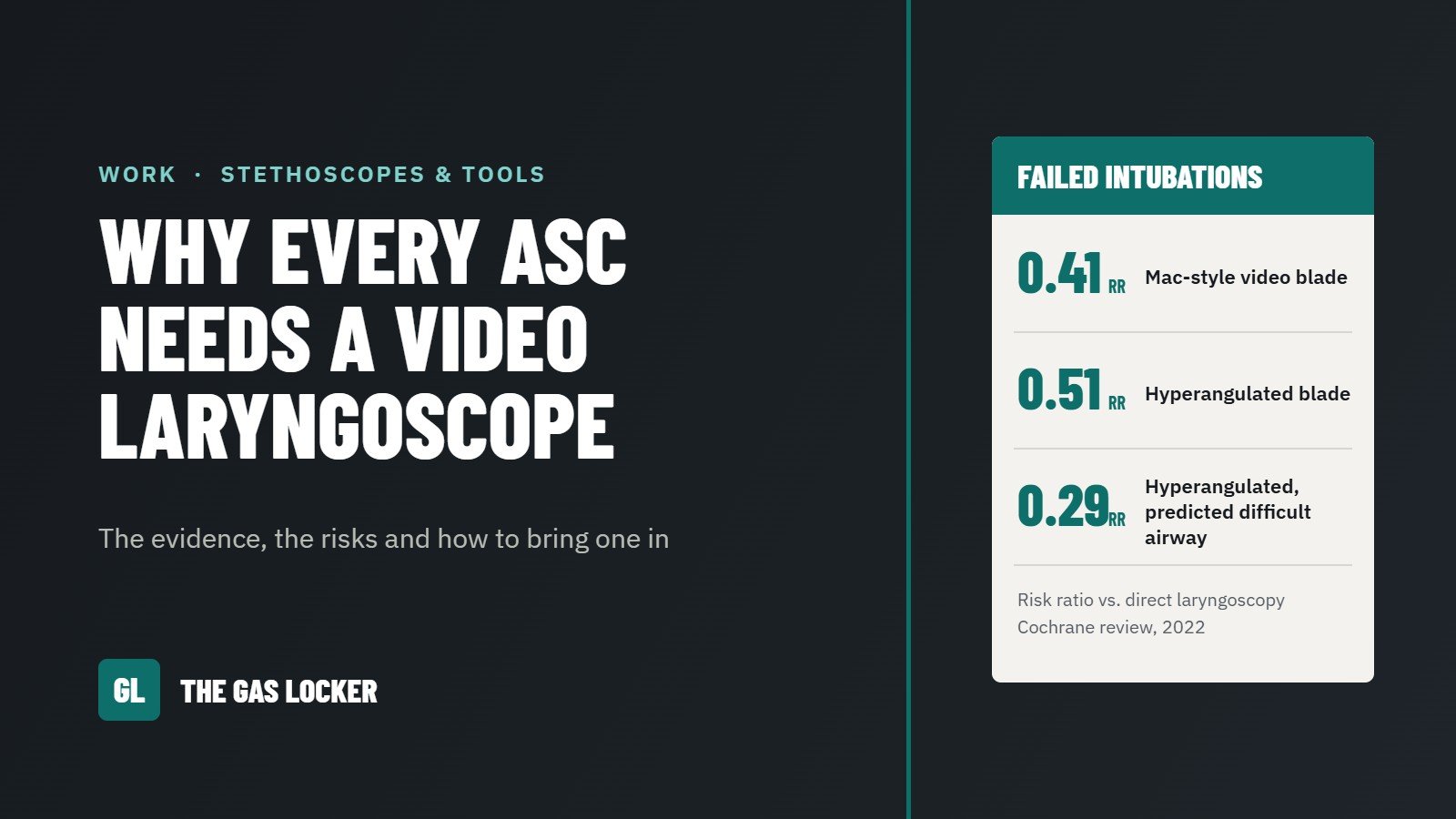
If you’re the only anesthesia provider in the building, a video laryngoscope is the cheapest insurance you can buy against a failed airway. The evidence says it cuts failed intubations roughly in half, and the surgery center is exactly where you have the least help when things go wrong.
Key takeaways
- Video laryngoscopes cut failed intubations roughly in half across 222 trials (Cochrane, 2022).
- In a surgery center the backup is often you, so a failed airway costs more there.
- Choose the blade on purpose: Mac-style works like what you know; hyperangulated blades need a stylet and practice.
- Trial a portable unit, track first-pass success, and keep your direct laryngoscopy skills sharp.
Last reviewed Oct 2026 · Written by a practicing CRNA
Why the surgery center is different
In a hospital OR, a failed airway means a second attending, a difficult airway cart and an ENT surgeon down the hall. In many surgery centers, the backup is you.
- Thin backup. Often one CRNA or one anesthesiologist covers the building. The second set of experienced hands may be across the facility or not there at all.
- No ICU. A patient who aspirates or needs a surgical airway gets transferred by EMS. Every minute of a failed airway costs more when the next level of care is a 911 call away.
- Healthier-looking, harder airways. Outpatient schedules now include patients with obesity, obstructive sleep apnea and short, thick necks who look fine on paper. Many are booked for a quick LMA case that turns into an intubation.
- Emergencies are rare, so skills get rusty. Most ASC cases are elective and smooth. The unanticipated difficult airway is the one you don’t rehearse.
The ASA’s Statement on Office-Based Anesthesia requires “emergency difficult airway management equipment” for anesthesia given in office-based settings. Surgery centers face the same thin backup, so the same logic applies, and a video laryngoscope is the most useful single item that phrase can mean.
What the studies show
The research consistently shows fewer failed intubations and better first-pass success with video. The biggest gains are in the difficult airways you most fear in an outpatient setting.
| Study | Who was studied | Key finding |
|---|---|---|
| Cochrane review, Hansel et al., 2022 | 222 trials, 26,149 adults | Failed intubation cut by about half with every type of video laryngoscope (risk ratio 0.41 to 0.51). In predicted difficult airways, hyperangulated blades cut failure by about 70% (RR 0.29). Less hypoxemia with Mac-style blades (RR 0.72). Fewer esophageal intubations with hyperangulated blades (RR 0.39). |
| DEVICE trial, Prekker et al., NEJM 2023 | 1,420 critically ill adults, 17 US EDs and ICUs | First-attempt success 85.1% with video vs. 70.8% with direct laryngoscopy. Severe complications were similar (21.4% vs. 20.9%). |
| Aziz et al., Anesthesiology 2011 | 2,004 GlideScope intubations at two academic centers | 97% overall success. Rescued 94% of failed direct laryngoscopies (224 of 239). Most failures were in patients with neck scars, radiation or masses. Serious airway injury in 0.3%. |
The guidelines have moved the same way:
- ASA Difficult Airway Guidelines, 2022: video laryngoscopy improves laryngeal views and first-attempt success in predicted difficult airways. It’s listed as both a first-line and a rescue option.
- Difficult Airway Society, 2025: recommends using video laryngoscopy as first-line wherever it’s available and notes that “universal use of videolaryngoscopy is increasingly expected.”
One caution on reading the evidence: DEVICE studied critically ill patients, not healthy outpatients. For a routine ASA 2 patient, the absolute gain is smaller. The value is in the case you didn’t see coming.
Benefits vs. risks
The benefits are large and well studied. The risks are real but mostly preventable with technique and training.
| Benefits | Risks and limits | How to manage it | |
|---|---|---|---|
| Success rate | Fewer failed intubations and more first-pass success, especially in difficult airways | “See the cords, can’t pass the tube” with hyperangulated blades | Use a preshaped rigid stylet matched to the blade; practice on easy airways first |
| Patient safety | Less hypoxemia; fewer unrecognized esophageal intubations | Soft palate and pharyngeal injury from a stylet passed blind into the mouth | Watch the tube enter the mouth before looking at the screen; confirm with capnography every time |
| Teamwork | Everyone sees the same view; a helper can give laryngeal pressure precisely; it’s a teaching tool | Too many people watching the screen and not the patient | Assign roles before induction; one person watches sats and the patient |
| Tough patients | Less neck movement needed; better for limited mouth opening, obesity, and suspected C-spine issues | Blood, secretions and fogging can blind the camera; neck scars, radiation or masses predict failure | Suction first; warm or anti-fog the lens; have a second-generation LMA and front-of-neck kit ready |
| Skills | Builds confidence for solo providers | Direct laryngoscopy skills fade if you never use them | Use a Mac-style video blade as a direct laryngoscope some of the time |
| Equipment | Portable units fit an ASC cart | Dead batteries, a missing blade size, a unit left in another room | Put it on the daily machine check, with a spare battery and every blade size stocked |
| Cost | Fewer rescue intubations, transfers and complications | Upfront device cost plus single-use blades per case | Get a trial and ask for a quote before buying (see below) |
Making it work in your center
Pick the blade style on purpose. Mac-style video blades work like the laryngoscope you already know, and you can use them as a direct laryngoscope too. Hyperangulated blades give the best view in the hardest airways, but they need a stylet and practice. If your center can have only one device, pick one that takes both blade types.
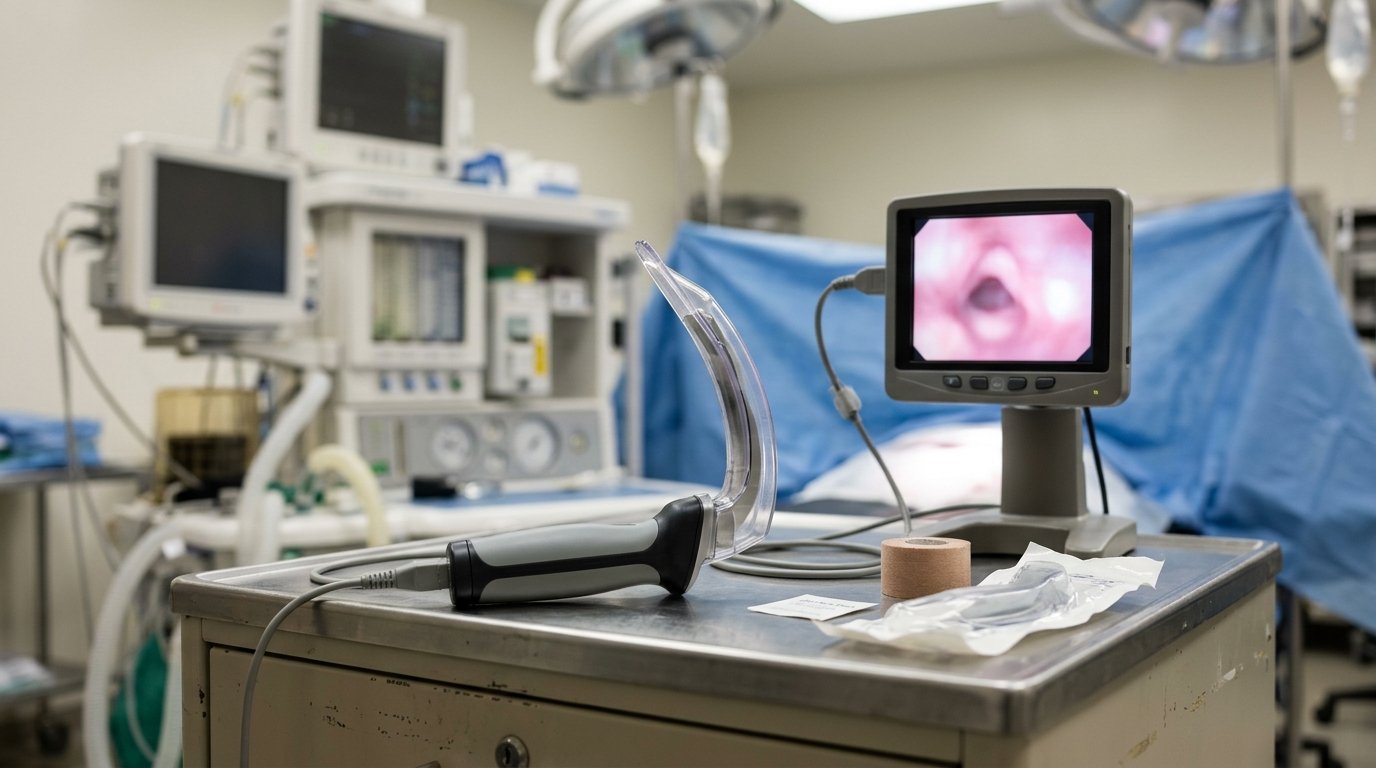
Portable beats big. Handheld units like the McGRATH MAC or GlideScope Go 2 fit on the anesthesia cart, run on batteries and go wherever you go: the procedure room, PACU or a code in the waiting area.
Single-use blades simplify ASC life. Reusable blades need high-level disinfection between cases. Many surgery centers don’t have the reprocessing staff for that. Disposable blades add a cost per case but take reprocessing off your plate.
Ask the rep the right questions:
- Can we trial a unit across all our providers for 2 to 4 weeks?
- What does each blade cost, and is there volume pricing?
- What’s the warranty, and do you loan a unit during repairs?
- Do you provide in-service training at our site?
- How are blades and handles cleaned, and has our infection-control team signed off?
Run the trial like a mini study. Loop in biomed and infection control before first use. Then track first-pass success, cases where you switched devices, and any airway trauma. That data is what convinces a medical director or owner to buy.
Keep your direct laryngoscopy skills. Use the video screen as a backup view some of the time and look directly first. Guidelines still expect you to be able to intubate without the screen.
Bottom line
A video laryngoscope won’t replace your judgment, your LMA or your front-of-neck plan. But the data are clear: it roughly halves failed intubations and gets the tube in on the first try more often. That matters most where backup is thinnest. For a CRNA working alone in a surgery center, it isn’t a luxury. It’s standard equipment that hasn’t caught up with the standard of care yet.
Curious how we got here? From Mirrors to Monitors traces the laryngoscope from mirrors to screens.
FAQ
Do I still need direct laryngoscopy skills?
Yes. Guidelines still expect you to be able to intubate without the screen. Using a Mac-style video blade as a direct laryngoscope some of the time keeps those skills sharp.
Mac-style or hyperangulated blade?
Mac-style blades work like the laryngoscope you already know and double as a direct laryngoscope. Hyperangulated blades give the best view in the hardest airways but need a stylet and practice. If your center can have only one device, pick one that takes both.
Does it matter for healthy outpatients?
For a routine ASA 2 patient, the absolute gain is smaller than in the trials of critically ill patients. The value is in the unanticipated difficult airway, which is exactly when backup is thinnest in a surgery center.
What are the main risks?
“See the cords, can’t pass the tube” with hyperangulated blades, soft palate injury from a stylet passed blind into the mouth, and a camera blinded by blood, secretions or fogging. A preshaped stylet, watching the tube enter the mouth, suction and anti-fog handle most of it. Confirm every tube with capnography.
Reusable or single-use blades?
Reusable blades need high-level disinfection between cases, which many surgery centers aren’t staffed for. Single-use blades add a cost per case but take reprocessing off your plate.
Sources
- Hansel J, et al. Videolaryngoscopy versus direct laryngoscopy for adults undergoing tracheal intubation. Cochrane Database Syst Rev, 2022
- Prekker ME, et al. Video versus direct laryngoscopy for tracheal intubation of critically ill adults (DEVICE). NEJM, 2023 (summary)
- Aziz MF, et al. Routine clinical practice effectiveness of the Glidescope in difficult airway management. Anesthesiology, 2011
- APSF update: 2022 ASA Practice Guidelines for Management of the Difficult Airway
- Ahmad I, et al. Difficult Airway Society 2025 guidelines for management of unanticipated difficult tracheal intubation in adults. Br J Anaesth, 2025 (NYSORA summary)
- ASA Statement on Office-Based Anesthesia (amended Oct 23, 2024)
- Two case reports of soft palate perforation during video laryngoscope-assisted intubation. BMC Anesthesiology
This is educational content based on published research and guidelines, not medical advice or a product endorsement. There are no affiliate links in this article. General information, not medical advice. Everything here reflects my personal views and opinions, based on my own experience and research. It isn’t a substitute for your facility’s policies or your own clinical judgment. Inline image: AI-generated via Google Gemini.