Gear, fitness and money for OR pros. Written by a practicing CRNA.

Follow @thegaslockerhq

Category: Body

Staying fit and rested around long cases and odd hours.

  • Fit on a Clinician’s Schedule: How I Fit Workouts, Meal Prep and Family Around Shift Work

    Fit on a Clinician’s Schedule: How I Fit Workouts, Meal Prep and Family Around Shift Work

    The Gas Locker may earn a commission when you buy through links on this page. It doesn’t change what we recommend.

    Most clinicians don’t need another article telling them to eat protein and lift weights. We know what to do. The hard part is fitting it around 12-hour shifts, call nights and a family that needs you when you walk in the door.

    For me, the answer wasn’t more motivation. It was taking decisions out of my day. This is the system I use to stay consistent on a clinician’s schedule, plus the research on what actually counts.

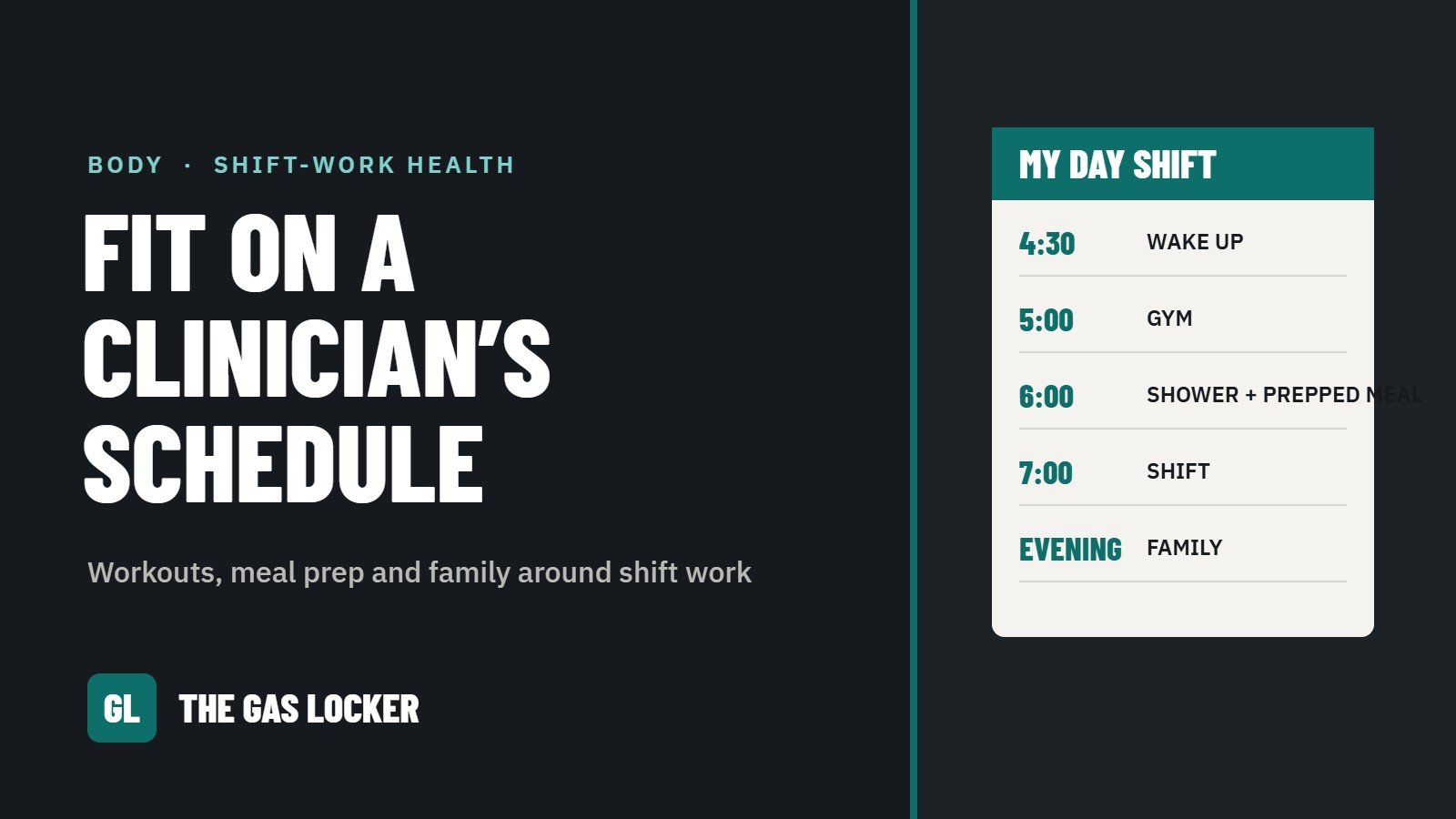
    My take: Time is my biggest challenge, like it is for most of us. Family comes first, always. Once they’re taken care of, I take care of my workout. What made it work was cutting out everything that eats time: thinking about what to cook, what to wear and what comes next. When those decisions are already made, there’s room for everything else.

    What actually counts

    According to the CDC, adults need about 150 minutes of moderate activity a week (like brisk walking), or 75 minutes of vigorous activity (like running), plus muscle-strengthening work at least 2 days a week. The good news for shift workers: it can be broken into smaller chunks, and the CDC says some activity is better than none.

    That means a 10-minute walk between cases, a quick hotel-room circuit on a travel contract, or a family bike ride all count. You don’t need perfect weeks. You need a routine you can keep during your worst week.

    Rule 1: Build the workout around the shift

    Don’t try to find time. Assign it. Here’s how I plan around different shifts:

    ShiftWhen I trainWhy it works
    Day shiftWake at 4:30, gym at 5:00, quick workout before workIt’s done before the day can get in the way
    Night shiftRight after work, on the post-call dayBefore sleep and life pull me in other directions
    Days offAfter family is taken care of, often with the familyNo choosing between family time and fitness

    My take: On day shifts, I wake up at 4:30 and I’m at the gym by 5 for a quick workout before my shift. On night shifts, I go right after work on my post-call day. If I can’t make it to the gym, the family works out with me.

    A note on post-call workouts: if you’re truly exhausted, keep it light. A walk or mobility session still counts, and sleep is part of the plan too.

    Rule 2: Remove every decision you can

    Decision fatigue is real, especially after a day of making decisions that matter. The less you have to think about fitness and food, the more likely you are to do it.

    • Same gym clothes, multiple colors. Pick one brand and style you like, and buy several. You never think about what to wear.
    • Gym bag packed the night before. Clothes, shoes, headphones, shaker bottle, a protein bar. Grab it and go.
    • A fixed weekly menu. The same handful of meals every week. No thinking about what’s for lunch.
    • A set routine after the workout. Know exactly when you’ll shower, eat and head to work.
    • A plan for each day of the week. Decide on Sunday which days you train, not in the moment.

    My take: I wear the same brands of gym clothes, just in multiple colors, so I never think about what to wear. I keep a strict routine for what I eat each week. Taking those choices out of the equation is what lets me get everything done efficiently.

    Rule 3: Put your food on autopilot

    You don’t need a complicated diet. You need meals that are quick, filling and high in protein, ready before the week starts.

    My go-to meal prep list

    • Proteins: chicken breast, tuna, chicken salad
    • Carbs: rice, potatoes and sweet potatoes
    • Grab-and-go: protein shakes and protein bars
    • Snacks: high-protein, nutrient-dense options you can eat between cases

    A simple weekly prep routine

    1. Pick one afternoon, like Sunday, for prep.
    2. Cook a big batch of protein, such as a tray of chicken breasts.
    3. Cook a big batch of carbs, like rice and roasted potatoes or sweet potatoes.
    4. Portion everything into containers for the week.
    5. Stock your bag and locker with shakes and bars for long days.

    My take: I keep meals simple and high in protein so I don’t have to think about them. And I eat with a purpose: to meet my nutritional needs, not just to eat because food is there.

    Intermittent fasting: what it is and who it’s for

    Intermittent fasting focuses on when you eat rather than what you eat. A common approach is 16/8, where you eat within an 8-hour window and fast for the other 16. For some shift workers it simplifies the day: fewer meals to plan and prep.

    It isn’t for everyone. Johns Hopkins Medicine says it isn’t recommended for people under 18, anyone pregnant or breastfeeding, people with type 1 diabetes who take insulin, or anyone with a history of eating disorders, and it recommends talking to your doctor before starting, especially if you have a chronic condition or take medication.

    My take: Intermittent fasting is a big part of what works for me. It keeps my eating simple and intentional. But it’s my approach, not a prescription. Talk to your own doctor before trying it.

    Rule 4: Bring the family into it

    If you have kids or a partner, workouts don’t have to compete with family time. Some ideas:

    • Family walks, hikes or bike rides on days off
    • Backyard or living-room circuits where kids join in
    • Cooking and portioning meal prep together
    • Weekend outdoor activities that keep everyone moving

    My take: Family is always part of my routine. On days I can’t get to the gym, I get the family involved and we work out together.

    A 20-minute workout for busy days

    When you only have 20 minutes, a simple full-body circuit covers your strength days. Do 3 rounds, resting as needed:

    1. Squats: 12–15 reps
    2. Push-ups (from the knees is fine): 8–12 reps
    3. Resistance band or dumbbell rows: 12 reps
    4. Reverse lunges: 10 per leg
    5. Plank: 30–45 seconds

    Scale it to your fitness level, and check with your doctor before starting a new exercise program if you have health concerns.

    Sleep is part of the plan

    Early workouts and night shifts only work if you protect your sleep. On post-call days especially, don’t trade sleep for a hard workout if you’re running on empty. If you want to track how your sleep and recovery are going, see The Best Smartwatches for OR Pros.

    Your bad-week backup plan

    Some weeks, everything falls apart. When that happens, keep just these three:

    1. A 10-minute walk every day you can.
    2. Your prepped protein and a shake instead of vending-machine food.
    3. One 20-minute workout, even if it’s the only one that week.

    Then get back to the full routine next week. Consistency beats perfection.

    Gear that saves time

    • A dedicated gym bag that stays packed
    • Several sets of the same workout clothes
    • Meal prep containers that are microwave- and dishwasher-safe
    • A shaker bottle for protein shakes
    • Resistance bands or adjustable dumbbells for home and hotel workouts
    • An insulated lunch bag to keep prepped meals cold through a shift

    Full guides to home gym gear and meal-prep gear are coming soon.

    FAQ

    Is it better to work out before or after a shift?

    Whichever one you can do consistently. Before a day shift gets it done before the day takes over. After nights, going straight from work can work well, as long as you’re not too exhausted.

    How much exercise do I really need?

    The CDC recommends about 150 minutes of moderate activity a week plus 2 days of strength training, and it can be broken into short sessions.

    Do I have to try intermittent fasting?

    No. It works for some people and not others. Meal prep and high-protein, simple meals help whether you fast or not. Talk to your doctor before starting.

    What if I have no time at all this week?

    Use the bad-week backup plan: daily short walks, your prepped food, and one 20-minute workout.

    Sources

    General information, not medical, nutrition or fitness advice. Everything here reflects my personal views and opinions, based on my own experience and online research. Talk to your doctor before starting a new exercise or eating plan.
  • The Best Compression Socks for Long Cases (and Why Your Socks Matter More Than You Think)

    The Best Compression Socks for Long Cases (and Why Your Socks Matter More Than You Think)

    The Gas Locker may earn a commission when you buy through links on this page. It doesn’t change what we recommend.

    By hour ten of a long case, a lot of OR staff know the feeling: heavy, achy legs and swollen ankles, even in great shoes. Anesthesia work makes it worse, because so much of it is standing in one spot at the head of the bed, where your calf muscles aren’t doing much to push blood back up.

    Good socks are the cheapest fix in your locker. Compression socks go a step further. Here’s why both matter, how to pick the right compression level, and the pairs worth buying.

    My take: I don’t wear compression socks myself, so this guide is built on research, not personal testing. After writing my shoe guide, though, it was obvious that socks are the other half of the equation, and this is where I’d start.

    Quick picks

    • Best overall: Comrad CloudCotton Compression Socks, 15–20 mmHg (about $38)
    • Best for cold ORs and sweaty feet: Sockwell Circulator, 15–20 mmHg, merino wool blend
    • Best for first-timers: Ostrichpillow Bamboo Compression Socks, 8–15 mmHg (about $29)
    • Best everyday brand: Bombas Everyday Compression Socks, 15–20 mmHg (about $30)
    • Most stylish: Vim & Vigr, 15–20 mmHg (about $54)
    • Best budget: Charmking Compression Socks, 15–20 mmHg (about $30 for a multi-pack)

    Why your socks matter more than you think

    Most people spend real money on shoes, then wear whatever socks are in the drawer. On a 12-hour shift, that’s a mistake:

    • Sweat and blisters. Feet sweat inside closed shoes all day. Cotton holds that moisture against your skin, which leads to rubbing, blisters and odor. Merino wool and synthetic blends pull moisture away instead.
    • Cushion where it counts. Light padding under the heel and ball of the foot adds comfort on hard OR floors without crowding your shoes.
    • Fit changes everything. A thick sock can make a well-fitting shoe too tight, and a thin one can make it sloppy. Try shoes on with the socks you’ll actually wear at work.
    • Temperature. ORs run cold. A merino blend keeps feet warm when the room is cold and still breathes when you’re moving.

    Why compression helps on long cases

    When you stand still for hours, gravity makes blood and fluid pool in your lower legs. Walking helps, because your calf muscles squeeze blood back toward your heart, but standing at the head of the bed doesn’t give them much to do.

    Compression socks apply gentle pressure that’s strongest at the ankle and eases up the leg. A medical consensus statement on compression therapy found that 15–20 mmHg stockings can relieve the leg symptoms that come with jobs that require prolonged standing, and that even low-pressure socks can reduce swelling. The general rule is to use the lowest pressure that relieves your symptoms.

    Compression levels, explained

    LevelPressureGood for
    Mild8–15 mmHgFirst-timers and anyone who wants light support
    Moderate15–20 mmHgThe sweet spot for most long shifts on your feet
    Firm20–30 mmHgStronger support; worth asking your doctor first
    Extra-firm30–40 mmHgMedical-grade; generally by prescription

    Who should check with a doctor first: according to Cleveland Clinic, skip compression socks if you have open wounds, skin infections or very fragile skin, and talk to your provider before wearing them if you have peripheral artery disease, reduced feeling in your legs (such as diabetic neuropathy) or sudden, unexplained swelling.

    What to look for

    1. 15–20 mmHg for most people. Start with mild compression if you’ve never worn them.
    2. Graduated compression. Tightest at the ankle, looser toward the knee.
    3. Knee-high length. The standard for work. Stop just below the knee crease.
    4. Breathable fabric. Nylon-spandex, merino, bamboo or modal blends. Avoid heavy cotton-only socks.
    5. The right size. Compression sizing is based on calf and ankle measurements, not just shoe size. Check the brand’s size chart.

    The full reviews

    Best overall

    Comrad CloudCotton Compression Socks

    Comrad is one of the most popular compression brands with healthcare workers, and the CloudCotton line is built for all-day wear. It uses moderate 15–20 mmHg compression in a soft blend of nylon, combed cotton, micro modal and lyocell, and NBC Select named it the best compression sock for daily wear in 2026.

    Pros

    • Moderate compression that works for full shifts
    • Soft, breathable blend
    • Lots of colors and patterns

    Cons

    • Pricier per pair than budget packs
    • Some Comrad styles are snug to pull on

    Best for: anyone who wants one reliable pair to wear every shift.

    Best for cold ORs and sweaty feet

    Sockwell Circulator

    The Circulator is built around a merino wool blend with bamboo rayon, nylon and spandex, at 15–20 mmHg. Merino keeps feet warm in cold ORs while pulling sweat away, which helps with blisters and odor on long days.

    Pros

    • Merino keeps feet warm and dry
    • Moderate graduated compression
    • Fun patterns

    Cons

    • Wool blends need gentler washing
    • Availability varies by size and color

    Best for: cold rooms, sweaty feet and anyone who likes merino.

    Best for first-timers

    Ostrichpillow Bamboo Compression Socks

    If you’ve never worn compression, start here. At a mild 8–15 mmHg, these feel closer to a snug everyday sock than a medical stocking. They’re made with a bamboo blend, and NBC Select picked them as its best compression sock overall in 2026.

    Pros

    • Gentle compression that’s easy to get used to
    • Soft bamboo blend
    • Affordable at about $29

    Cons

    • Too light if you already have significant swelling
    • Less support than 15–20 mmHg picks

    Best for: trying compression for the first time.

    Best everyday brand

    Bombas Everyday Compression Socks

    Bombas is known for comfortable everyday socks, and its compression line brings the same feel at 15–20 mmHg. It’s an easy one to find, and NBC Select called it the best compression sock for recovery.

    Pros

    • Moderate compression
    • Comfortable, familiar feel
    • Easy to find

    Cons

    • Cotton-heavy blend is less wicking than merino or synthetics

    Best for: people who already like Bombas and want compression in the same style.

    Most stylish

    Vim & Vigr

    Vim & Vigr is the fashion pick, with bold patterns and colors that look nothing like medical stockings. It offers 15–20 mmHg compression in nylon-spandex, and Reviewed rated it one of the best options for everyday wear.

    Pros

    • Standout designs
    • Moderate compression
    • Good for everyday wear

    Cons

    • Among the most expensive at about $54 a pair

    Best for: people who want compression socks that look like regular fun socks.

    Best budget

    Charmking Compression Socks

    Charmking sells 15–20 mmHg compression in multi-packs for around $30, which makes it an easy way to have a fresh pair for every shift.

    Pros

    • Very low cost per pair
    • Moderate compression
    • Multi-packs mean one for every shift

    Cons

    • Reviewers note they wear out faster than premium pairs

    Best for: students, new grads and building a big rotation cheaply.

    Don’t want compression? Upgrade your regular socks

    Compression isn’t for everyone. Even without it, switching from cotton to a merino or synthetic work sock with light cushioning and a seamless toe can make long shifts noticeably more comfortable. Keep a spare pair in your locker for days when your feet get wet.

    How to wear them

    • Put them on in the morning, before swelling starts. Cleveland Clinic recommends taking them off before bed.
    • Turn them inside out to the heel, slide your foot in, then roll the rest up. No bunching or folding at the top.
    • Rotate a few pairs and wash them gently so the elastic lasts.
    • Replace them when they start feeling loose or easy to pull on. That means the compression is fading.

    FAQ

    What compression level should I start with?

    For most people, 15–20 mmHg is the sweet spot for long shifts. If you’re new to compression, mild 8–15 mmHg is an easy way to start.

    Should I wear compression socks every shift?

    Many OR staff do, especially on long days. Try them for a few shifts and see how your legs feel by the end.

    Who shouldn’t wear compression socks?

    Skip them if you have open wounds, skin infections or very fragile skin, and talk to your provider first if you have peripheral artery disease, neuropathy or unexplained swelling.

    Do compression socks go with any shoe?

    Yes, but they add some thickness. Try your work shoes on with them. See The Best Shoes for 12-Hour OR Shifts for picks.

    Sources

    General information, not medical advice. Everything here reflects my personal views and opinions, based on online research. Talk to your doctor if you have ongoing leg pain or swelling.

  • The Best Smartwatches for OR Pros: Sleep, Recovery and Battery Life Around 12-Hour Shifts

    The Best Smartwatches for OR Pros: Sleep, Recovery and Battery Life Around 12-Hour Shifts

    The Gas Locker may earn a commission when you buy through links on this page. It doesn’t change what we recommend.

    Most smartwatch reviews are written for runners and office workers. OR life is different. You need a watch that lasts through a long shift or a call night, tracks sleep that happens at 9 a.m., buzzes you awake without waking the house, and wipes clean between cases.

    I’ve worn the same Garmin for three to four years of OR and procedure work, so this guide starts there, then covers the best options for every budget and phone.

    My take: I wear a Garmin Fenix 6 through OR cases and procedure-based work, and I’ve had it for three to four years. It’s easy to read at a glance with big, high-contrast numbers, and the screen doesn’t glow with bright colors, so it’s easy on the eyes during night cases. I also use it to track steps and hikes. And since I trade stocks, the big, readable notifications mean I can check a market alert between cases without pulling out my phone.

    Quick picks

    • Best for OR pros: Garmin Instinct 3 Solar (about $300–$400)
    • Best premium Garmin: Garmin Fenix 9 (from $999.99)
    • Best for iPhone users: Apple Watch Series 12 (from $399)
    • Best screen-free tracker: WHOOP (membership from $199 a year, band included)
    • Best if you can’t wear a watch: Oura Ring 4 (from $349, plus $5.99 a month)
    • Best budget Garmin: Garmin Instinct E ($199.99)

    What to look for in a watch for OR life

    1. Battery that outlasts your shift. A watch that dies on a call night is useless. Multi-day battery life means you’re not scrambling for a charger between cases.
    2. A screen that’s easy on tired eyes. Always-on memory-in-pixel (MIP) screens, like on my Fenix 6, stay readable in bright OR lights and don’t blast you with light at 3 a.m. Bright AMOLED screens look sharper but glow more.
    3. Sleep tracking that handles day sleep. After nights, you sleep when everyone else is awake. Look for trackers that detect naps and off-hours sleep automatically.
    4. Silent vibration alarms. Wake up for call without waking your partner or kids.
    5. A band that wipes clean. Silicone or nylon handles hospital disinfectant wipes. Leather doesn’t.
    6. Your facility’s rules. Anyone scrubbed in can’t wear a watch. Non-scrubbed roles like anesthesia often can, but policies vary, and some hospitals require bare arms below the elbow. Check yours first.

    The full reviews

    Best for OR pros

    Garmin Instinct 3 Solar

    If you want what I love about my Fenix 6 without paying flagship prices, this is the watch. The Instinct 3 Solar uses a monochrome memory-in-pixel screen that’s easy to read in bright OR lights and gentle at night, and its solar lens stretches battery life to what Garmin calls unlimited in smartwatch mode with enough daylight. It comes in 45mm and 50mm sizes.

    Pros

    • Screen is easy to read and easy on the eyes
    • Battery life measured in weeks, not days
    • Tough, simple and wipeable

    Cons

    • Monochrome screen looks basic
    • Rugged style isn’t for everyone

    Best for: anyone who wants long battery life and an easy-to-read screen for shift work.

    My take: This is what I’d buy if I were replacing my Fenix 6 today. It has the same kind of easy-to-read, low-glare screen I rely on, at well under half the price of Garmin’s newest flagship. I haven’t worn it myself yet.

    Best premium Garmin

    Garmin Fenix 9

    Garmin’s newest flagship launched in August 2026 and is the direct successor to the Fenix line I wear. It has a brighter AMOLED screen, comes in 43mm, 47mm and 51mm sizes, and the largest version gets up to 29 days of battery in smartwatch mode. The Fenix 9 Pro adds a titanium case, and select Pro models offer solar charging.

    Pros

    • Garmin’s most complete feature set
    • Long battery life for an AMOLED watch
    • Three sizes

    Cons

    • Expensive, starting at $999.99
    • Bright AMOLED screen glows more than my Fenix 6 at night

    Best for: people who want the best Garmin makes and use it heavily for training and outdoors.

    My take: I haven’t worn the Fenix 9. It’s the upgrade path from my Fenix 6, but for OR life I’d honestly rather save the money and get an Instinct 3 Solar.

    Best for iPhone users

    Apple Watch Series 12

    If you live in the iPhone world, the Apple Watch is the most seamless option for texts, calls and app notifications. The Series 12 launched in September 2026 with an upgraded heart rate sensor that checks every five seconds, HRV tracking and a new readiness score based on your activity, vitals and sleep. The rugged Ultra 4 ($799) adds more than two days of battery life.

    Pros

    • Best iPhone integration
    • Strong new health and readiness features
    • Huge choice of bands

    Cons

    • Needs charging much more often than a Garmin
    • Bright screen at night
    • Only works with iPhone

    Best for: iPhone users who want notifications and health tracking in one device.

    My take: I haven’t used an Apple Watch. The battery life is the dealbreaker for me on long shifts and call nights.

    Best screen-free tracker

    WHOOP

    WHOOP has no screen at all, just a sensor band that tracks sleep, recovery and strain and sends it to your phone. That makes it a favorite with healthcare workers: no notifications during cases and nothing to glance at. Plans run from $199 to $359 a year with the band included, and battery life is 14+ days.

    Pros

    • No screen, no distractions
    • Excellent sleep and recovery tracking
    • 14+ day battery

    Cons

    • Ongoing subscription
    • Can’t tell time or show alerts

    Best for: people who want sleep and recovery data without a watch face at work.

    My take: I haven’t tried WHOOP. It’s the opposite of what I use, since I want my alerts on my wrist, but it makes sense if your facility is strict about watches.

    Best if you can’t wear a watch

    Oura Ring 4

    The Oura Ring tracks sleep, heart rate and HRV from your finger, with 7 to 8 days of battery. It’s one of the best sleep trackers you can buy, which matters a lot for night-shift sleep. The ring costs $349 to $499, and full features need a membership of $5.99 a month.

    Pros

    • Top-tier sleep tracking
    • Nothing on your wrist
    • About a week of battery

    Cons

    • Rings have OR rules too, so check your policy
    • Monthly membership for full features

    Best for: people who can’t wear a watch at work and care most about sleep.

    My take: I haven’t worn an Oura. If sleep after nights is your biggest struggle, this is the one I’d look at first.

    Best budget Garmin

    Garmin Instinct E

    The Instinct E is the entry point to Garmin’s rugged line at $199.99. It skips extras like solar charging, the built-in flashlight and Garmin Pay, but keeps the core Garmin fitness and sleep tracking.

    Pros

    • Lowest price here
    • Garmin’s fitness and sleep tracking
    • Rugged build

    Cons

    • No solar charging
    • Fewer features than the Instinct 3
    • 40mm only

    Best for: students, new grads and anyone trying Garmin for the first time.

    My take: I haven’t tried the Instinct E. It’s a smart way to see if you like Garmin before spending more.

    How we chose

    We started with the watches and trackers healthcare workers use most, then compared battery life, screen type, sleep tracking and price using manufacturer specs and recent reviews. Prices are what we saw at last check and change often. For transparency: I wear a Garmin Fenix 6. The other picks come from research, and I’ll update this guide as I try them.

    FAQ

    Can I wear a smartwatch in the OR?

    If you’re scrubbed in, no. If you’re not scrubbed, it depends on your facility. Many allow watches for anesthesia staff, but some require bare arms below the elbow. Check your policy.

    Which watch has the best battery life?

    Garmin, by a wide margin. The Instinct 3 Solar can run indefinitely in smartwatch mode with enough daylight, and even Garmin’s AMOLED watches last weeks. Apple Watch needs much more frequent charging.

    What’s the best sleep tracker for night shift?

    For sleep alone, the Oura Ring 4 and WHOOP are the most sleep-focused. If you also want a watch, Garmin and Apple both track sleep well.

    How do I clean my watch at work?

    Wipe the watch and band with an approved hospital disinfectant wipe, and stick to silicone or nylon bands. Check your manufacturer’s cleaning guidance.

    My Fenix 6 is getting old. Should I upgrade?

    If it still works for you, there’s no rush. When it’s time, the Instinct 3 Solar keeps the same easy-to-read screen style for much less than a new Fenix.

    General information, not medical advice. Everything here reflects my personal views and opinions, based on my own experience and online research.