
Your retirement app has a lot of red in it right now. The S&P 500 dropped more than a tenth from its October record in a matter of weeks, and it did it fast.
Our December 2018 vs. December 2026 article covers why markets fell. This one covers the question that actually keeps people up after a call shift: what, if anything, should you do with your 403(b), 457 and IRA?
The short answer
For most people who are years from retirement, the steady moves tend to matter most: keep contributing, don’t sell in a panic, and check that your mix of stocks and bonds still matches your plan. A drop can also be a moment to learn how Roth conversions work and how your 457(b) is different from your 403(b). Nobody knows where the market goes next, and this is education, not advice.
What actually happened
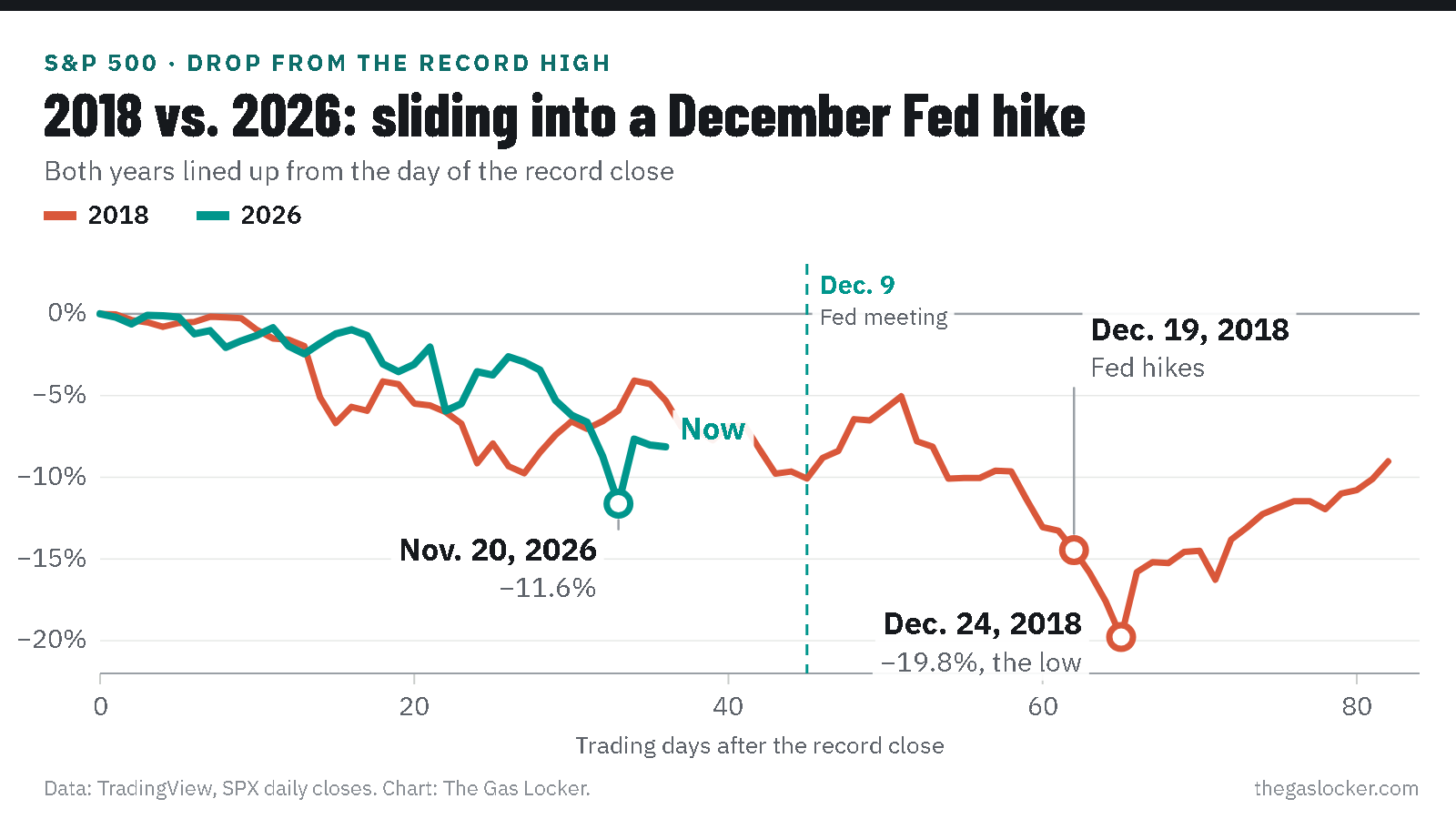
The S&P 500 set a record on October 6. By the close on November 20 it had fallen for seven sessions in a row and sat more than a tenth below that record. Wall Street calls a drop of that size a “correction.” The selling was led by AI and chip stocks, with a Fed meeting on December 9 hanging over everything.
Then came a sharp bounce. By the close on November 25, the index had won back part of the loss and sat roughly one-twelfth below its high. The swings in between were large in both directions.
That is the whole story in three sentences. For the charts and the Fed backdrop, see the December comparison and our earlier look at midterm-year markets.
Keep contributing: the quiet move that does the work
In the OR, a dip in blood pressure gets a calm look at the whole picture before anyone reaches for a syringe. A dip in your account deserves the same.
If you contribute from every paycheck, a lower market simply means the same contribution buys more shares than it did in October. You don’t have to do anything clever. The payroll deduction does it for you, every two weeks, without asking how you feel about the headlines.
This isn’t a promise that prices come back on any schedule. It is just how steady contributions work: you buy at high prices, low prices and everything in between, and you never have to guess which is which. Stopping contributions during a drop means skipping the lower prices and, for many W-2 CRNAs, leaving an employer match on the table.
Don’t panic-sell: what Christmas Eve 2018 teaches
The last time the Fed raised rates into a falling market, it looked like this:
- September 20, 2018The S&P 500 closes at a record.
- December 24, 2018The low. The index is down about one-fifth from its high, after its worst December since 1931.
- April 23, 2019A new record close, about four months after the low.
Someone who sold on Christmas Eve 2018 locked in the full drop and then had to decide when to get back in, while the market climbed without them. Someone who did nothing was back to even by spring.
Not every drop recovers that fast, and some take years. The lesson isn’t “it always bounces.” It is that selling turns a paper loss into a real one, and it forces you to be right twice: once on the way out and again on the way back in.
Rebalance, in plain words
Say your plan is a certain mix of stock funds and bond funds. When stocks fall, the stock side shrinks and your mix drifts away from the plan. Rebalancing just means moving things back to the mix you picked.
Two things make this less scary than it sounds. First, inside a 403(b), 457 or IRA, moving between funds generally doesn’t create a tax bill. Second, many plans can do it for you: target-date funds rebalance on their own, and some plans have an automatic rebalance setting.
If you own a single target-date fund, you may have nothing to do here at all. If you built your own mix, a drop like this is a reasonable time to look. Our guide to CRNA retirement accounts walks through each account type.
Roth conversions in a down market: the general idea
A Roth conversion moves money from a pre-tax account, like a traditional IRA, into a Roth IRA. You pay income tax on what you move in the year you move it. After that, it can grow and come out in retirement without more tax, as long as the Roth rules are met.
Why do people look at this when markets are down? Because the tax is based on the value on the day you convert. The same shares are worth less after a drop, so moving them costs less in tax, and any recovery happens inside the Roth.
There are real catches. The converted amount is added to your income for the year, which can push you into a higher bracket. Since 2018, a conversion can’t be undone. And nobody knows if prices fall further after you convert. This is one to run past a CPA before the year ends, since a conversion counts in the tax year the money actually moves.
457(b) vs. 403(b): the difference that shows up in a downturn
Many hospital-employed CRNAs have both a 403(b) and a 457(b). In good times they look like twins. The differences show up when someone needs money early or changes jobs.
| 403(b) | Governmental 457(b) | Nonprofit 457(b) | |
|---|---|---|---|
| Extra 10% tax on early withdrawals | Generally yes, before 59½ | No, except on money rolled in from other plans | Ask your plan |
| Can roll into an IRA | Yes | Yes | No |
| Whose money is it? | Held in your account | Held in trust for you | The employer’s until paid out |
Two points are worth slowing down for. With a governmental 457(b), the usual extra 10% tax on early withdrawals doesn’t apply once you’ve left that employer and take money out. Regular income tax still does. That makes it the more flexible account in a pinch, which is also a reason not to raid it lightly.
A 457(b) at a private nonprofit hospital is a different animal. The IRS says the money stays the property of the employer until it is paid to you, which means the employer’s creditors could reach it if the hospital ran into serious trouble, and it can’t be rolled into an IRA. If you aren’t sure which kind you have, your plan document or HR can tell you in one email.
The 1099 corner
If you work 1099, there is no payroll deduction doing the steady work for you. You are the payroll department. A falling market doesn’t change the rules: contributions to a Solo 401(k) or SEP-IRA still count the same way.
The calendar matters more than the market here. The IRS lets you set up and fund a SEP as late as your tax filing deadline, including extensions. A Solo 401(k) has two parts, your contribution as the “employee” and as the “employer,” and its timing rules are tighter. With December 31 coming, now is the time to ask your CPA which deadlines apply to you. Our 1099 CRNA starter guide covers the setup.
What not to do (and what tends to help)
Think twice before
- Selling everything because of one bad month
- Stopping contributions and missing the match
- Checking your balance every day
- Borrowing from or cashing out a plan to “wait it out”
- Making a big move based on a headline or a forecast
Steady moves
- Keep the paycheck contributions going
- Look at your stock and bond mix against your plan
- Find out which kind of 457(b) you have
- Ask a CPA about Roth conversions and year-end deadlines
- Keep an emergency fund in cash so you never have to sell low
FAQ
Should I stop contributing to my 403(b) when the market is falling?
Most long-term savers keep going. The same contribution buys more shares when prices are lower, and stopping can mean giving up an employer match. Your own situation may differ, so check with a financial professional.
Should I move my 403(b) to cash until things calm down?
Moving to cash after a drop locks in the loss and leaves you guessing when to get back in. After the December 2018 low, the S&P 500 was back at a record about four months later. Not every recovery is that quick, but nobody rings a bell at the bottom.
What is the difference between a 403(b) and a 457(b) for a CRNA?
Both let you save from your paycheck before tax. The big differences are in getting money out. Early withdrawals from a 403(b) generally carry an extra 10% tax before age 59½. A governmental 457(b) generally doesn’t after you leave the employer. A 457(b) at a private nonprofit can’t be rolled into an IRA and stays the employer’s property until paid.
Is a market drop a good time for a Roth conversion?
It can lower the tax cost, because the tax is based on the value on the day you convert. But the amount is added to your income that year, it can’t be undone, and prices can keep falling. It is worth a conversation with a CPA, not a snap decision.
What does “correction” mean?
It is Wall Street’s word for a drop of at least one-tenth from a recent high. A drop of at least one-fifth is called a bear market.
I’m an SRNA or new grad. Does any of this matter to me?
Yes, in a good way. If retirement is decades away, lower prices early on mean your first contributions buy more. The habit of contributing from every paycheck matters far more than this month’s headlines.
Sources
CNBC, Nov. 20, 2026 close · UPI, Nov. 20, 2026 · Motley Fool, Nov. 25, 2026 close · S&P Dow Jones Indices, April 24, 2019 · AP via KOMO, April 23, 2019 · S&P 500 daily closes, Yahoo Finance · IRS Topic 558, early distributions · IRS, exceptions to the tax on early distributions · IRS, tax-exempt vs. governmental 457(b) plans · IRS, non-governmental 457(b) plans · IRS, IRA recharacterization FAQs · Treasury Reg. 1.408A-4, Roth conversions · IRS, SEP FAQs · IRS, one-participant 401(k) plans
For general education only, not financial, tax or investment advice. Past patterns don’t predict future results. No buy or sell recommendations. Tax rules have exceptions; check with a CPA or your plan. Cover and charts built from S&P 500 daily closes (Yahoo Finance). No affiliate links.