
Three years ago, a CRNA could pick almost any city, name a schedule and have a recruiter call back within the hour. Those days are fading. The jobs haven’t gone away. They’ve moved.
Nobody can see 2027 yet, but the 2025 and 2026 numbers point in a clear direction. Here’s where the work is heading: which settings, which parts of the country, and what kind of jobs.
The short answer
There are still plenty of CRNA jobs, but the hiring rush is cooling. New CRNAs are now arriving faster than new jobs. The work is moving out of the main OR and into surgery centers and procedure rooms, and toward rural and fast-growing states. Contract work has stopped growing, and more offers are W-2.
The big picture: jobs vs. CRNAs
The whole market comes down to two numbers.
- About 530 new CRNA jobs a year. There are about 54,500 CRNA jobs today, and about 59,800 are expected by 2035.
- About 1,900 more CRNAs a year. Roughly 3,300 graduate and 1,400 retire or leave.
Key pointThat’s three to four new CRNAs for every new job.
Jobs vs. CRNAs
Every year: 530 new jobs, 1,900 more CRNAs
Rounded yearly numbers at today’s pace
Sources: BLS employment projections 2025 to 2035 (jobs); NBCRNA certification counts and Above the Drapes (new and departing CRNAs). The full math is in our oversupply article.
“The market is no longer moving in one direction everywhere, all at once.”
That’s how a surplus starts. It doesn’t arrive all at once with CRNAs out of work. It shows up first as small shifts: a few markets cooling while others stay hot, fewer bidding wars, offers that stop rising. Pharmacy went through exactly this a decade ago, and our oversupply article walks through how it played out. Those early signs come years before the numbers officially tip.
Where does that lead? The federal workforce forecast has about 1,600 more CRNAs than jobs by 2028, and about 5,200 more by 2033. That’s a small gap in a workforce of nearly 70,000. But it’s the first time in years the numbers point that way, and graduating classes are still growing toward about 4,000 a year.
Could it turn around? It has before. A CRNA surplus was predicted for 2020 and never came, because surgery centers and procedure rooms grew faster than anyone expected. If that happens again, new jobs could reach 2,200 to 3,300 a year.
So what is 2027? Not a shortage anymore, and not a surplus yet. About even. That means jobs are still easy to find, but where you look matters more than it used to. The full math, including retirements, is in Too Many CRNAs? The Early Signs Are Already Here.

What the job postings show
Job boards are where a cooling market shows up first. GasWork, the board most of us use, doesn’t allow its listings to be used for research, so we left it out and used published job-posting reports instead.
- Openings are still plentiful. About 8,800 CRNA jobs were open nationwide from April to September 2026. That’s about 11 for every 100 working CRNAs.
- Many are short-term, depending on where you are. Nationally, 59% of those openings were locums or contract. Rural and hard-to-staff areas drive that number. In a crowded metro, most open jobs may be W-2.
- CRNAs top the locum lists. On one major locum platform, nearly 1 in 5 shifts posted in 2025 was for a CRNA.
The first dip
Starting offers stopped climbing
Change in starting offers for permanent CRNA jobs, 2025-26 vs the year before
Source: AMN Healthcare 2026 Review of Physician and Advanced Practitioner Recruiting Incentives, via Becker’s ASC. Academic offers rose 0.4%; the other two fell.
The jobs are still being posted. What changed is the offer. After years of increases, starting offers slipped, most of all outside academic centers. That’s what “about even” looks like: employers don’t have to keep raising the bid.
Where the cases are going
Anesthesia follows the cases, and the cases are leaving the main OR.
- Surgery centers. About 11,500 nationwide, up 15% in a decade. Every new room needs an anesthesia provider.
- Procedure rooms. GI, cath lab, electrophysiology and interventional radiology. These cases have more than doubled in 20 years and are up to half the anesthesia work at some hospitals.
- Offices. Dental, oral surgery, plastics and GI offices are all hiring CRNAs, according to the AANA.
Surgery centers
Surgery centers are paying more to keep anesthesia covered
What surgery center leaders report
Centers expecting to pay an anesthesia stipend
Source: VMG Health, via Becker’s ASC (Sept. 2026).
Key pointHospitals still employ the most CRNAs, but the growth is outpatient. Fast turnovers, procedural sedation and working without a big department behind you are the skills that open doors.
Where the jobs are going
Demand isn’t the same everywhere. Tap a state to see what the reports say.
The map
Where CRNAs are needed most
Tap a state to see why. Based on 2025 and 2026 staffing reports.
Sources: Wellhart and Medicus Healthcare Solutions (2025) and Stout (2026), via AnesthesiaJobs. Staffing-industry data. Map outlines: U.S. Census Bureau.
By region
The Mountain states have the most open jobs per CRNA
Open jobs for every 100 CRNAs working in the region (April to September 2026)
Source: Anesthesia Operations Consultants, CRNA Pay Report Q3 2026 (public job postings).
Rural hospitals are the clearest case. More than 80% of anesthesia providers in rural counties are CRNAs, so when one retires, there’s often no one else to cover the room.
Key pointThe farther you are from a crowded, popular city, the more say you have over your schedule and terms.
1099 vs. W-2: how the jobs are changing
How CRNAs work
About one in five CRNAs works 1099, and that hasn’t changed in three years
AANA members by employment type, 2025
Source: AANA member data, 2025. In 2024 the group-employee share was 27%; the AANA reports the 1099 and hospital shares as about the same as prior years. “Other” is the remainder.
“We’re still needing 1099 CRNAs. We’re just not needing to add as many and as frequently as we have in the past.”
Read that closely. The need hasn’t gone away, but it isn’t growing the way it used to. Contract work is usually the first place a cooling market shows, because it’s the easiest coverage for a facility to cut. That’s the same early warning our oversupply article flagged in the 1099 and locum market, showing up before the bigger graduating classes have even arrived.
- Contract work has stopped growing. Contract pay still rose last year, but the AANA says growth is slowing and some areas have leveled off. Locum rates that spiked during the scramble are easing.
- Hospitals are hiring their own anesthesia staff. Hospital-owned anesthesia practices grew from about 23% to 35% of the market from 2012 to 2024.
- Contract jobs look different now. Many 1099 roles are long-term at one site, not travel assignments.
Key pointNationally, contract work hasn’t shrunk. It has stopped growing. If it feels like it has vanished where you live, that’s a local story: crowded markets where employers don’t need contract terms to fill a room.
We’ve asked for data comparing 1099 and W-2 listings over the past few years, and we’ll add it here if we get it.

Weighing a contract offer? Our guide to cash anesthesia rates and negotiation and the 1099 CRNA starter guide walk through the math.
What could change the picture
| Force | Which way it pushes |
|---|---|
| Bigger graduating classes | ⬇️ More supply. New programs are still producing their first classes |
| Retirements | ⬆️ Some openings. About 1,400 CRNAs leave each year, but the workforce isn’t getting older |
| Payer cuts | ⬇️ Fewer CRNA-only jobs. Some insurers pay about 15% less for non-medically directed billing |
| Scope-of-practice changes | ⬆️ More independent jobs. Ohio loosened its supervision rules in 2025 |
| Anesthesiologist assistants | ⬇️ More competition in care-team states |
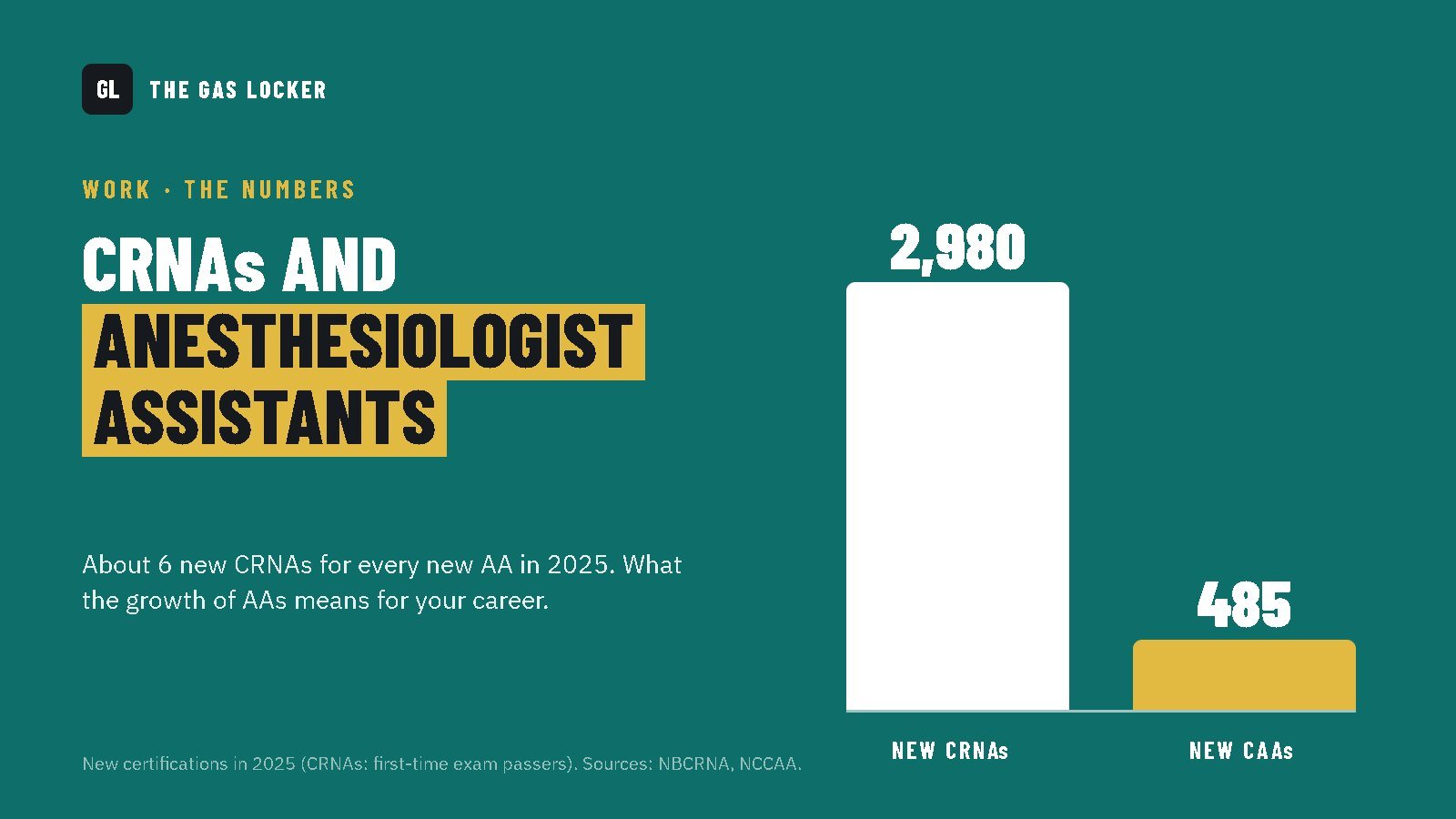
Anesthesia forecasts have missed in both directions before. If outpatient cases keep growing fast, the extra graduates get absorbed. If insurers keep cutting, the squeeze spreads sooner. More on the last row in CRNAs and Anesthesiologist Assistants.
What it means for you
Stay open on location
You’ll still have offers. What’s changing is how many you’ll have in the exact city you want. Flexibility for your first two or three years is worth more now than it was for the classes ahead of you.
Build outpatient skills
Efficient turnover, procedural sedation, regional blocks and comfort working solo are what’s in demand. A stretch in a surgery center or procedure suite widens your options.
Know your number
Expect steadier rates and fewer bidding wars. Know what your work is worth before you negotiate, and keep an eye on W-2 offers. GasRate can help you value a case.
Follow the demand
Rural and fast-growing states are where employers are working hardest to hire. That’s where you’ll have the most say over schedule and terms.
The bottom line
- Jobs aren’t disappearing. They’re still being added, just more slowly than new CRNAs.
- Location matters more every year. Rural and fast-growing states have the most room to negotiate.
- Outpatient skills travel. Surgery centers and procedure rooms are where the cases are growing.

FAQ
Is the CRNA job market slowing down?
It’s cooling from a peak, not shrinking. Jobs are still being added, but the frantic hiring of 2021 to 2024 has eased in many places.
Where are CRNAs needed most?
Rural areas, the Midwest and Mountain West, parts of the Southeast, and fast-growing states like Texas and Florida. Surgery centers and procedure rooms are adding the most cases.
Is 1099 work going away?
No. About one in five CRNAs works contract, and that share has held steady for three years. But rates are leveling off and more new offers are W-2.
Should new grads be worried?
Not about finding a job. Be ready to be flexible about where, especially for your first one.
Will there be too many CRNAs?
The federal forecast shows slightly more CRNAs than jobs by 2028, and a bigger gap by 2033. Past forecasts have missed in both directions, so watch the trend rather than bet on it.
Sources
- BLS Occupational Outlook Handbook: nurse anesthetists
- HRSA nursing workforce projections (Dec 2025)
- NBCRNA NCE and SEE annual report, 2025
- AANA: The current landscape of 1099 CRNAs (Oct 2026)
- AANA: Flexibility vs. stability, how CRNAs are employed (Oct 2026)
- Anesthesia Operations Consultants: CRNA Pay Report Q3 2026, job posting data
- Becker’s ASC: CRNA starting salaries dip (AMN Healthcare 2026 recruiting review)
- Locumsmart: Healthcare staffing trends in 2026
- Stout: The anesthesiologist and CRNA staffing market (Feb 2026)
- Becker’s ASC: 5 forces shaping anesthesia in 2026
- Becker’s ASC: CRNAs are leaving hospital jobs, where are they going?
- Becker’s ASC: Who’s getting hit hardest by the anesthesia shortage? (Sept 2026)
- AnesthesiaJobs: Anesthesia provider demand by state (June 2026)
- Randy Moore, Inside Anesthesia: Anesthesia in 2026 (Jan 2026)
For general information only, not career, legal or financial advice. Job-posting, regional and setting figures come partly from staffing-industry and job-board reports, which can lean toward a shortage story; treat them as direction, not exact counts. No public source tracks total CRNA postings year over year. No affiliate links in this article. Photos AI-generated via Google Gemini; charts by The Gas Locker.