Can you really “release” your fascia with a foam roller? The short answer is no. The longer answer is more interesting, because fascia does matter, just not the way the ads say.
Here’s what the research actually supports, what’s marketing, and the simple training that works. Plus a two-minute routine you can do between cases.
The short answer
Fascia is real, and it matters more than old anatomy books gave it credit for. It senses, it passes force between muscles, and it slowly gets stronger with training. But you can’t “release” or “break up” fascia with a roller or your hands. It’s far too tough. Foam rolling gives a small warm-up boost and a little less soreness. What actually trains fascia is ordinary: lifting, jumping, moving in every direction, and patience.
What fascia actually is
Fascia is the connective tissue that wraps and links everything under your skin: every muscle, every bundle inside the muscle, and the sheets between them. If you’ve ever seen the thin silvery film on a chicken breast, you’ve seen fascia.
For a long time it was treated as packing material, the stuff you cut through to get to the interesting parts. That view has changed. Fascia is now studied as a body-wide network that does two jobs: it senses, and it passes force along.
Key pointFascia is the wrapping around everything under your skin. It senses, and it passes force along.
The anatomy, from the textbooks
Peel back the layers from the outside in, the way an anatomy text does, and you pass through fascia at every level.
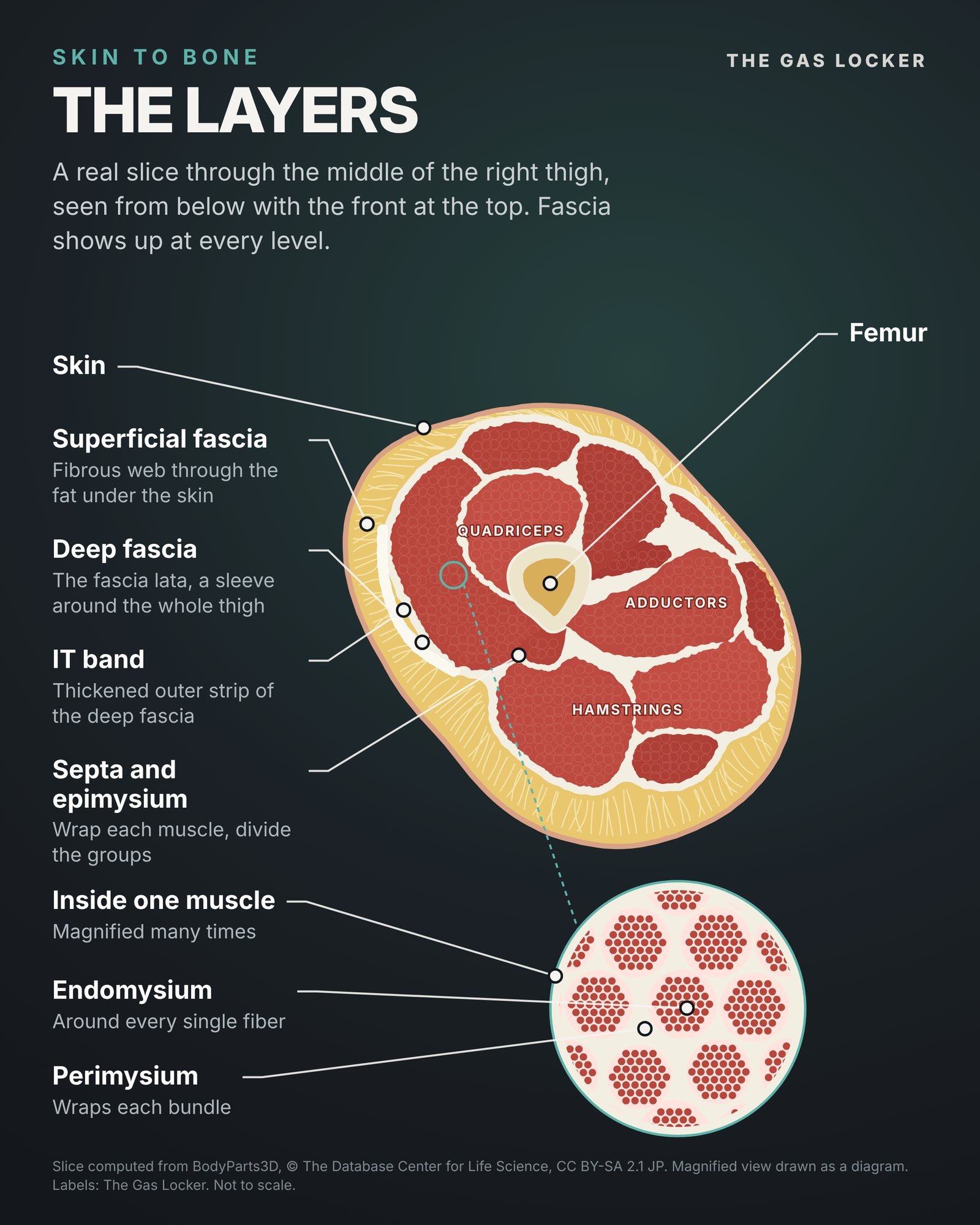
| Layer | Where it is | What it does |
|---|---|---|
| Superficial fascia | Just under the skin, woven through the fat layer | Lets skin slide over what’s beneath; carries nerves and vessels |
| Deep fascia | Under the fat, wrapping muscle groups | Dense, tough sheets that hold muscles in place and pass force along |
| Epimysium | Around each whole muscle | The muscle’s outer sleeve |
| Perimysium | Around each bundle of fibers | Groups fibers into working bundles |
| Endomysium | Around each single fiber | The finest layer, down at the cell |
It’s mostly collagen, the same strong protein in tendons, sitting in a watery gel. When that gel is healthy, neighboring layers slide freely over each other. One textbook compares it to an orange: the white pith that wraps the fruit, divides the segments and holds each tiny juice sac is the fascia. Take it away and the fruit has no shape.
Three pieces of fascia you already know
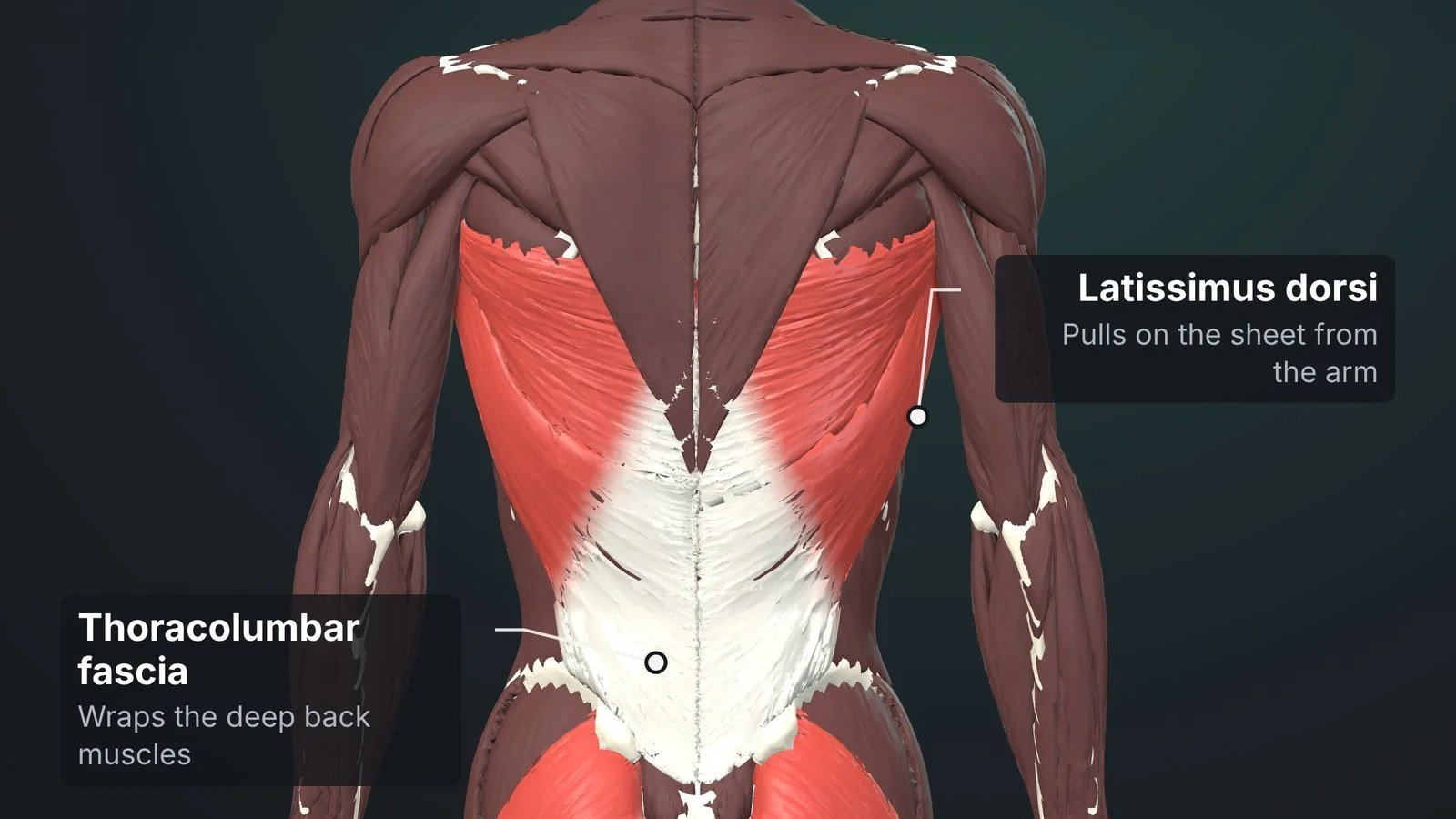
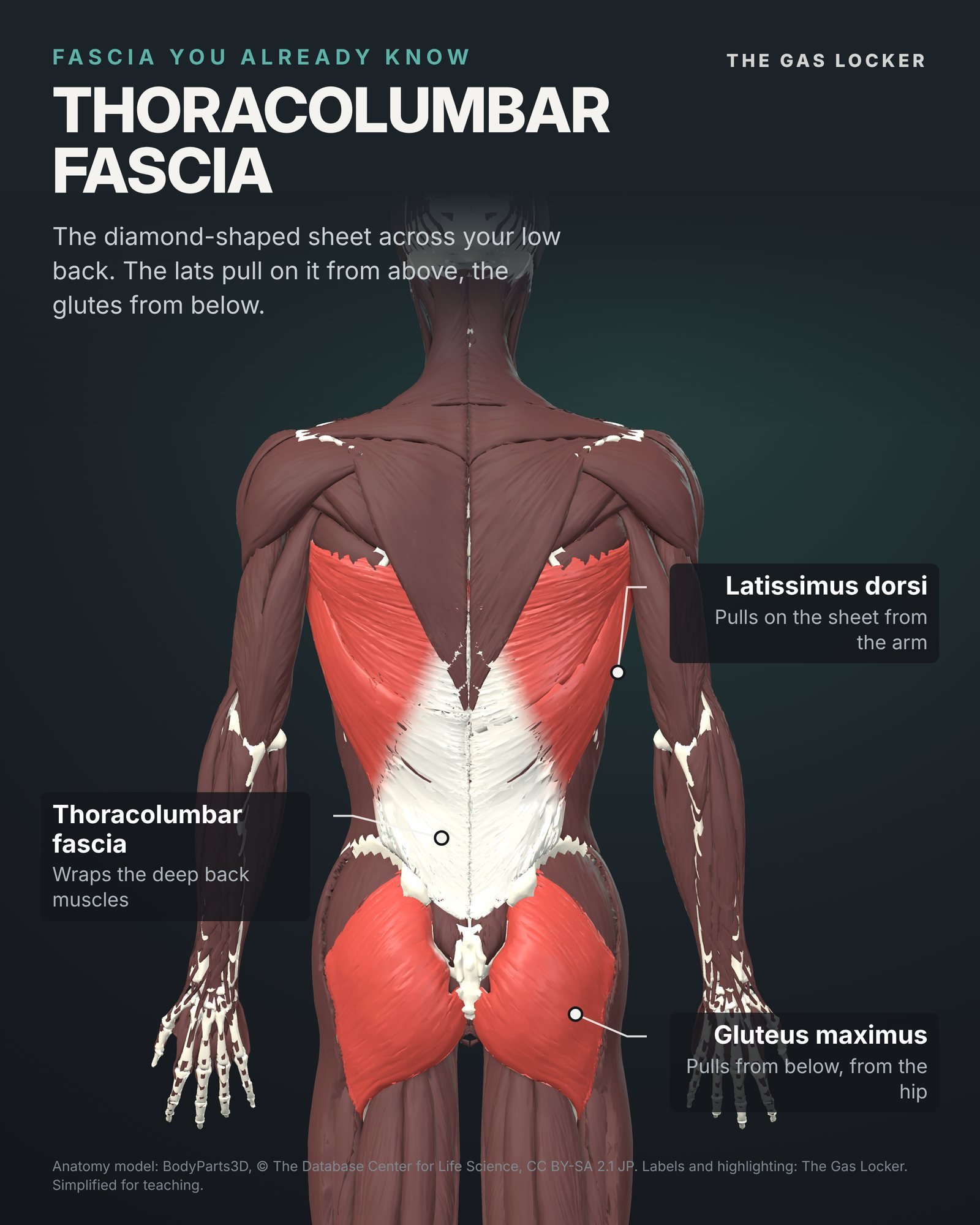
Thoracolumbar fascia. The broad diamond-shaped sheet across your low back. It ties the lats, glutes and deep back muscles together.
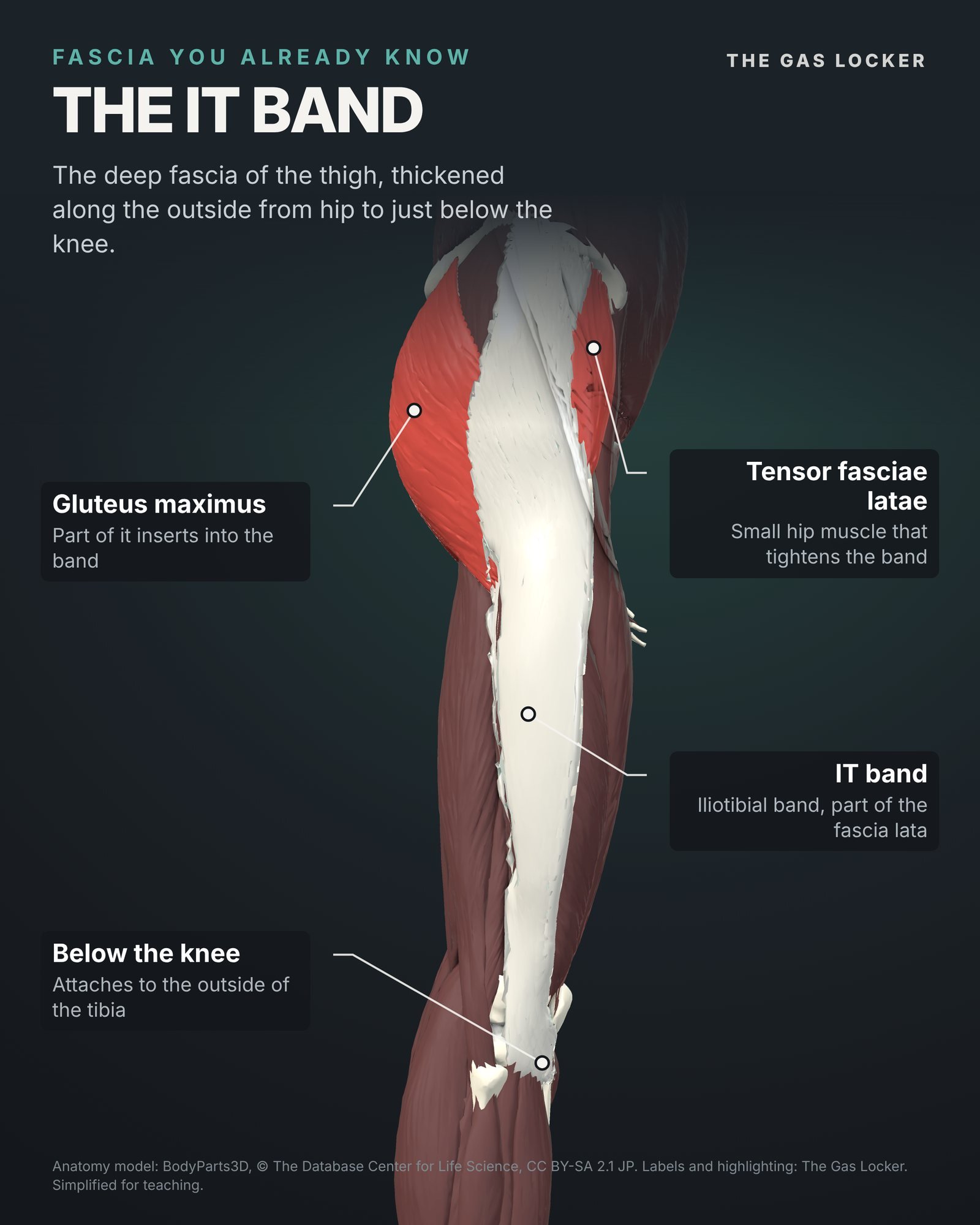
Fascia lata and the IT band. The stocking of deep fascia around the thigh, thickened along the outside into the iliotibial band.
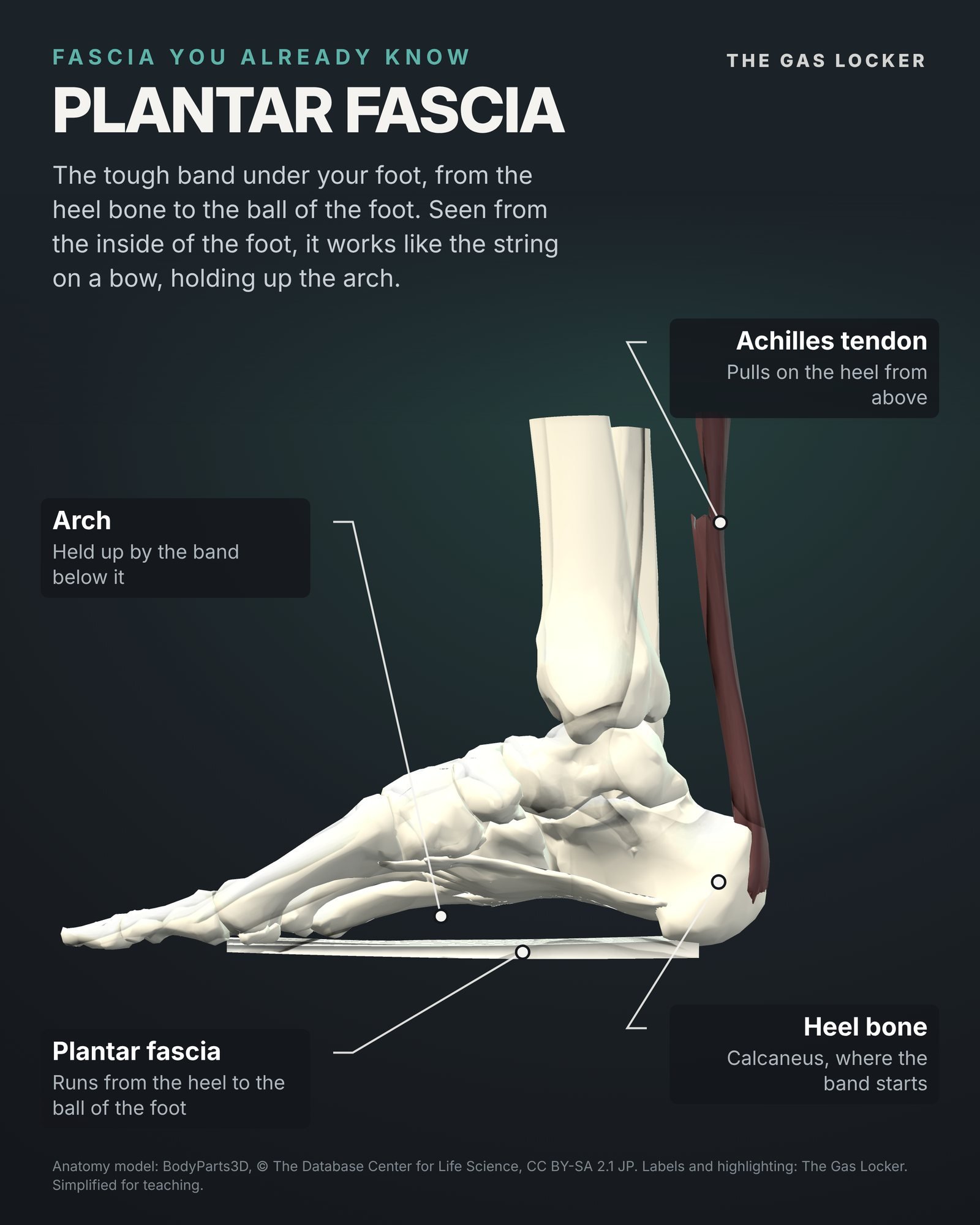
Plantar fascia. The tough band under the foot that supports the arch. Anyone who’s had plantar fasciitis has met it personally.
What the science supports
Four things hold up in the research:
- It senses. Fascia is full of nerve endings for pain and position, especially across the low back.
- It passes force. Muscles pull on each other through it, so a tight calf can show up somewhere else.
- Some “chains” are real. Three of the famous body-long lines hold up in dissection studies, including the back line from foot to skull.
- It adapts to training, slowly. Think months, not sessions.
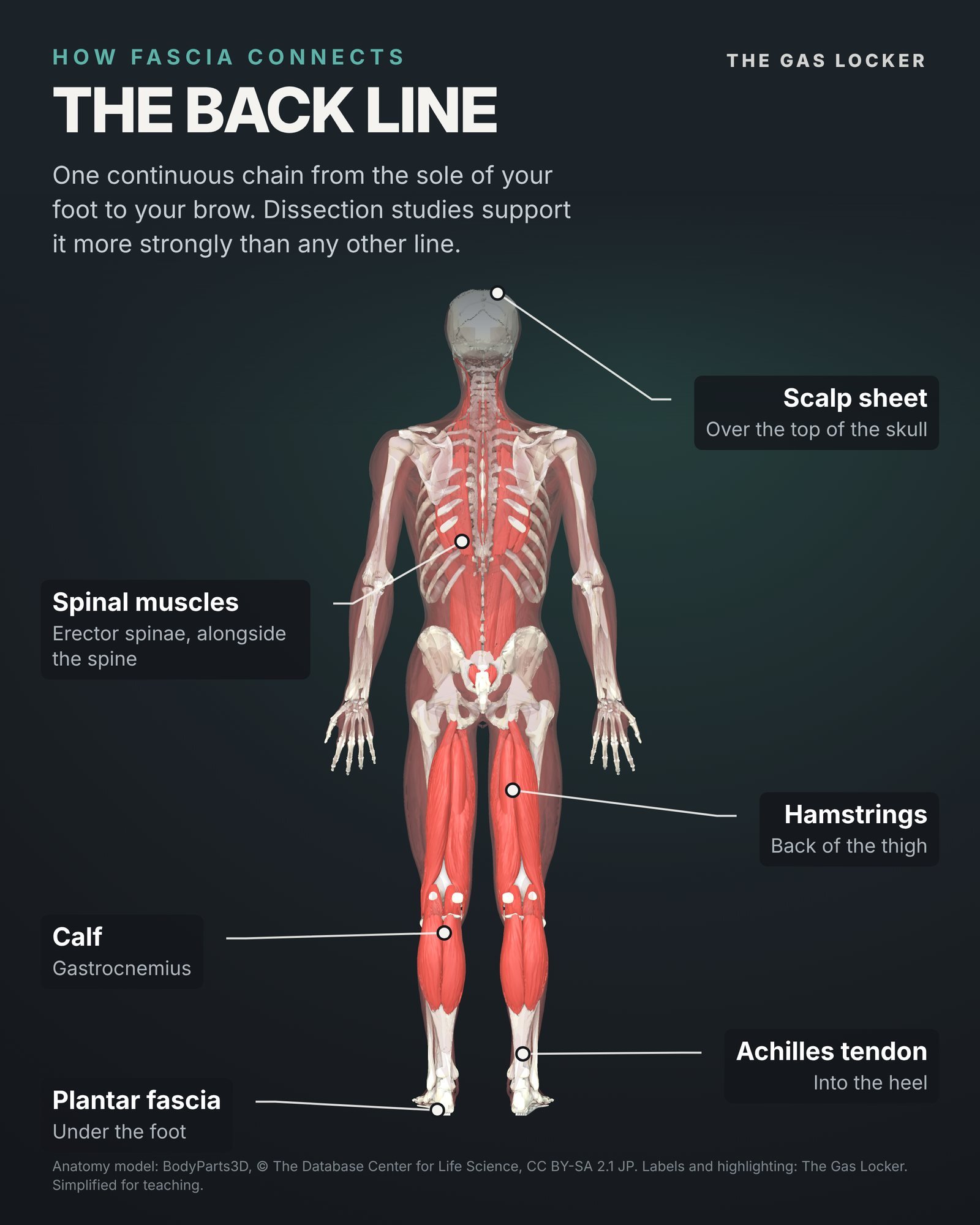
Key pointFascia matters. The science is about how it works, not about a special product that fixes it.
What’s hype
Here’s where the marketing gets ahead of the evidence.
| The claim | Verdict |
|---|---|
| Fascia matters for movement | ✅ Real |
| Fascial “chains” link the body | 🟡 Partly |
| Foam rolling helps | 🟡 A little |
| Drink more water to hydrate your fascia | ❌ No evidence |
| You can “release” fascia | ❌ Hype |
| “Knots” explain your pain | ❌ Hype |
| Minutes of rolling remodel tissue | ❌ Hype |
The “release” idea is the big one. Fascia is built to resist pulling. Even Robert Schleip, one of the best-known fascia researchers, concluded that permanently reshaping it with the kind of pressure a massage delivers is “impossible to conceive.” Whatever you feel loosen during a massage, it probably isn’t fascia. More likely your nervous system is easing off the tension in the muscle.
That doesn’t make the relief fake. It means the explanation on the box is wrong.
Same story with water. Fascia does contain water, but no study shows that drinking extra water changes your fascia. Drink to thirst, and drink more on long, hot shifts.
Foam rolling, honestly
The best evidence is a review that pooled 21 studies. Here’s what foam rolling actually did.
Foam rolling, measured
The real effects are small
Average change from foam rolling across 21 studies
Source: Wiewelhove et al., Frontiers in Physiology, 2019. The authors called the effects “minor and partly negligible.”
So keep the roller if you like it. It feels good and it gets you moving, which makes it a fine warm-up. Just don’t expect it to fix your posture, lengthen your muscles or “break up” anything.
How to train it for real
You don’t need a fascia class. Connective tissue gets stronger when you load it, and good training already does that. Here are your options, ranked from best to least by the strength of the evidence.
| Rank | What to do | How to start |
|---|---|---|
| 1. Best | Lift, and add weight over time | Two or three full-body sessions a week. Add weight slowly when the last reps feel easy |
| 2 | Jump and bound | Jump rope or small hops for a few minutes, twice a week. Build up over weeks, not days |
| 3 | Walk and run | A daily walk counts. Add easy runs if your joints are happy |
| 4 | Move in every direction | Add side lunges, twists and carries to workouts you already do |
| 5 | Stretch and mobilize | Helps range of motion. Best after training, not before |
| 6. Least | Foam roll or massage gun | Fine as a warm-up. Doesn’t change the tissue |
Key pointWhichever you pick, be patient. Muscle adapts in weeks. Connective tissue takes months.
Should you stretch before lifting? Not with long holds. Holding a stretch for a minute or more right before heavy lifting can briefly sap strength and power. Warm up with a few minutes of light movement, some leg swings or arm circles, and lighter sets of the lift itself. Save the long stretches for after training or a separate session.
One thing the research doesn’t show: that “fascia training” prevents injuries or builds strength better than a solid, varied program. If you’re lifting, moving and staying consistent, you’re already training your fascia.
For OR people
No one has studied fascia in OR staff specifically. But the job is the opposite of what the tissue likes: hours standing in one spot, one posture at the head of the bed, sometimes under a lead apron. The fix is variety.
The two-minute reset
No equipment, no floor. Do it in the hallway or the break room, never at the sterile field.
- Calf raises, 30 seconds. Slow up, slow down. Wakes up the calves and the plantar fascia.
- Hip hinges, 30 seconds. Hands on hips, push your hips back and stand tall. Loads the whole back line.
- Doorway chest opener, 30 seconds. Forearms on the door frame, lean through gently. Undoes the hunch over the anesthesia cart.
- Walk, 30 seconds. Down the hall and back. Easy and normal.
- Change position often. Shift your stance, sit if the case allows, step back when you can.
- Load it outside work. Two or three strength sessions a week do more for your back than any gadget. Short on time? See how to fit training around shift work.
- Look after your feet. The plantar fascia takes the whole shift. Good shoes and compression socks help it last. Love clogs? Read are Crocs comfortable for 12-hour shifts? before you buy.
When it’s more than tightness
Stiffness that eases as you warm up is normal. Some things aren’t, and they deserve a visit to your physician:
- Pain that lasts more than a few weeks or keeps getting worse.
- Pain that wakes you at night.
- Numbness, tingling or weakness in an arm or leg.
- Heel or back pain that changes how you walk.
A roller won’t fix those, and neither will this article. Your physician or a physical therapist can sort out what’s going on.
The bottom line
- Fascia is real and it matters. It senses, passes force and adapts.
- You can’t release it with a roller. Use the roller as a warm-up, not a fix.
- Train it the boring way. Lift, jump, move in every direction, and give it months.
FAQ
What is fascia, in one sentence?
The connective tissue that wraps and links your muscles, from the sheet under your skin down to the sleeve around each muscle fiber.
Can you really “release” fascia?
Not in the way the ads describe. It’s too tough to reshape with hands or a roller. What you feel is more likely the muscle relaxing.
Is foam rolling worth doing?
If you like it, yes. Expect a small warm-up benefit and slightly less soreness, not a transformation.
Do I need special fascia training?
No. Lifting, jumping, walking and moving in different directions already load it.
Should I stretch before lifting?
Skip long static holds right before heavy sets. Warm up with light movement and lighter sets instead, and stretch afterward.
Does drinking more water hydrate my fascia?
There’s no evidence that it does. Drink to thirst, and more on long or hot shifts.
How long until fascia adapts?
Longer than muscle. Think months of consistent training.
Are the fascial “lines” real?
Some are. The back line and two functional lines hold up well in dissection studies. The front line doesn’t.
Sources
- Fascial innervation: a systematic review (Suarez-Rodriguez et al., Int J Mol Sci, 2022)
- Reduced thoracolumbar fascia shear strain in chronic low back pain (Langevin et al., BMC Musculoskelet Disord, 2011)
- What is evidence-based about myofascial chains? (Wilke et al., Arch Phys Med Rehabil, 2016)
- A meta-analysis of the effects of foam rolling on performance and recovery (Wiewelhove et al., Front Physiol, 2019)
- What are fascia? (excerpt from Myofascial Training, Albini, Human Kinetics)
- Fascia Without the Hype (IDEA Health & Fitness Association)
- Fascia Science Review (PainScience)
- Robert Schleip on manual pressure and fascia, as cited by PainScience
- BodyParts3D anatomy database (source of the anatomy models used in our pictures)
For general education only, not medical advice. Talk to your physician about pain or injury, and before starting a new exercise routine if you have a health condition. Anatomy pictures made from BodyParts3D, © The Database Center for Life Science, licensed CC BY-SA 2.1 JP; labels and highlighting by The Gas Locker, shared under the same license. No affiliate links in this article.